
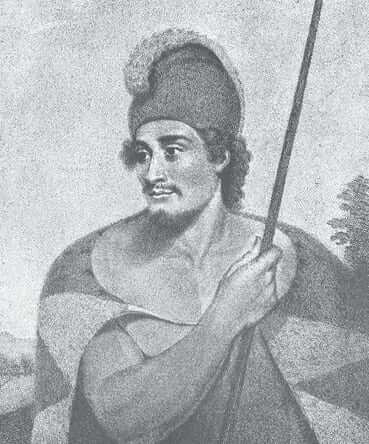
“E lī ana i luna i lalo ʻeuʻeu kōlea i ka puapua, kōlili na koʻo o ke koaʻe i ka makani, kaha ka uwau i ka mālia, kuehuehu ke kanaka eia ka hanu; ei ala!” (The blood will run cold, constantly stirring fear, fluttering like the tail of the koaʻe in the wind, the shearwater swoops in the stillness, the men catching the breath; I am here!).
Samuel M. Kamakau memorialized this battle cry of Kaʻiana ʻAhuʻula, a chief sent to make war with Keoua Kuʻahuʻula by Kamehameha I. But who was Kaʻiana ʻAhuʻula and what happened to him?
One of the most iconic lithographs made of an 18th century Hawaiian was based on a painting by Spoilum, a Chinese artist in Canton. It depicts a handsome, well-muscled Hawaiian warrior with contemplative features holding a spear and wearing a mahiole and ʻahuʻula. Below the sketch are the words, “Tianna a Prince of Atooi.” This is how most Hawaiians know of Kaʻiana.
There are many Kaʻiana – Kaʻiana, Kaʻiana Ukupē, and Kaʻiana ʻAhuʻula – found in stories recorded by Kamakau, Fornander, and Desha. It is often difficult to discern whether this is one person or several.
ʻO ʻAhuʻula ke kāne, ʻo Kaupekamoku ka wahine. Hānau kā lāua ʻo Keawe Kalanikuaiwa Kaʻiana a ʻAhuʻula he kāne. According to Kamakau, Kaʻiana’s father is ʻAhuʻula.
ʻAhuʻula is the son of Keawekekahialiʻiokamoku. ʻAe, THAT Keawe who is mentioned in the Kumulipo.
Kaʻiana is related to high-ranking chiefly lines from Hawaiʻi, Maui, and Oʻahu through both of his parents. Arguably, Kaʻiana might outrank Kamehameha’s genealogy.
It is unclear whether Kaʻiana was born on Kauaʻi or if his parents moved there after his birth, but he was raised there with his siblings (hoahānau) Namakeha and Nahiolea. With training in engineering, architecture, genealogies, weather and omen predictions, Kaʻiana was a learned man. Not much else is recorded about his youth.
Kamakau recounts that Kaʻiana sailed abroad for three years to various Asian and American lands befriending many along his travels. It is noted that he walked with distinction dressed in his mahiole and ʻahuʻula wherever he went, drawing crowds of people. He learned how to use swords and various munitions, and to speak other languages including English and Cantonese, learning about the daily lives of the peoples he visited.
When he returned home to Hawaiʻi, he was gifted cattle, goats, horses, citrus, plants, various weaponries, and gun powder – but the only things that survived the long voyage were his weapons.
When Kaʻiana arrived at Kealakekua, Kamehameha I was impressed by his ability to communicate with the foreigners and with his supply of weapons. Kamehameha gifted Kaʻiana with land and 12 waʻa kaulua adorned with ʻahuʻula to pursuade him to join his war campaign against Keoua, who was Kaʻiana’s first cousin.
Kaʻiana’s skill in communicating with foreigners was extremely valuable. He became an arms dealer for Kamehameha, Kahekili, Kāʻeokūlani and other chiefs who wanted to acquire the war tech of that era.
Kaʻiana also managed to impress several aliʻi wahine, including Kaʻahumanu and her mother, Nāmahana, who became his spies. He eventually had two wives, Kekupuohi and Loʻe. Kaʻiana also had a daughter, Kamakahalahalawai, whom he raised on Kauaʻi.
Kaʻiana and his siblings fought in most of Kamehameha’s battles on Hawaiʻi Island and Maui. Eventually, Kaʻiana became disenchanted with Kamehameha, and decided to support the Oʻahu people and Maui chief, Kalanikupule, after learning that there was a plot to remove him and his siblings from their status under Kamehameha’s leadership.
Kaʻiana and his siblings perished at Laʻimi during the Battle of Nuʻuanu.

