

By Charlene Kehaulani Kazner
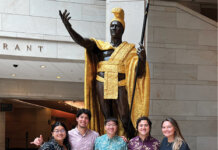
At its 2025 annual Scholarship ʻAhaʻaina, ʻĀinahau o Kaleponi Hawaiian Civic Club (AOKHCC) will celebrate 43 years of aloha! Established in February 1982 in Orange County, California, AOKHCC advocates for Native Hawaiians with a mission to perpetuate and promote Hawaiian cultural traditions, language, customs, and values.
“Eia Kaleponi, ʻāina one ʻula,” are the opening lyrics to the mele name song for AOKHCC composed by Dr. Amy Kuuleialoha Stillman, a professor and noted historian of the Pacific Islands and performance traditions of Hawaiʻi. The words honor members’ commitment to ʻāina, language, and culture while living in the vastness of California.
This oli makana remains in our repertoire, a proud proclamation of the cultural vitality that thrives here.

Under AOKHCC’s leadership and partnership with ʻAhahui o Liliuʻokalani HCC (Los Angeles) and ʻAhahui o Kalākaua HCC (San Francisco), alongside the consultation of AHCC President Jalna Keʻala, we developed the constitution and by-laws for the Mainland Council (MC).
The MC was chartered in November 1989 with AOKHCC and ʻAhahui o Liliʻuokalani, Nā Keiki o Hawaiʻi (Alaska), Hui Hawaiʻi o Utah, and Nā Poʻe o Hawaiʻi o Colorado.
AOKHCC’s Victor Kaiwi Pang served as MC’s first president. At the 2011 Association of Hawaiian Civic Clubs convention, Ike Kaʻaihue presented MC with the name Nā Lei Makalapua, symbolizing the many clubs on the continent connected like flowers in a lei.
Kaiwi, along with Jane Kaʻalakahikina Pang, both AOKHCC charter members and founding members of the MC, are also co-founders of Pacific Islander Health Partnership (PIHP), a nonprofit advocating for the CHamoru, Marshallese, Samoan, Tongan and Native Hawaiian (with AOKHCC representing Hawaiians) communities. PIHP convenes culturally focused, community-based organizations to create a unified base addressing health concerns across NHPI communities.
From 1989 through 2017, AOKHCC and PIHP hosted weekend ʻOhana Retreats at local universities facilitated by Native Hawaiian cultural practitioners from the pae ʻāina. These multi-generational retreats included workshops on ʻulana lauhala and lau niu, lei haku, kapa-making, hula, mele, ʻōlelo Hawaiʻi, food preparation, nā paʻani (games), and more.
In 2013, AOKHCC submitted a resolution, later passed into law, to provide non-resident tuition waivers for Native Hawaiian students attending the University of Hawaiʻi. To support cultural and educational opportunities, we have awarded over $300,000 at our annual scholarship lūʻau, benefitting many students. Every aspect of our lūʻau is handled by club members, ensuring pilina to our heritage.
Our kūpuna forged a path for nā ʻōpio to enact our club’s mission through educational and cultural scholarships, leadership development, mentorship and civic and community engagement. These efforts align with Prince Kūhiō Kalanianaʻole’s legacy of ensuring and improving the lives of Native Hawaiians wherein our culture, rights and wellbeing are protected and celebrated.
Charlene Kehaulani Kazner, born in Wailuku, Maui, and raised in Honolulu, Hawaiʻi, is currently a director and past pelekikena (president) of ʻĀinahau o Kaleponi Hawaiian Civic Club, and the corresponding secretary for the Mainland Council of the Association of Hawaiian Civic Clubs. She is also the board secretary for Pacific Islander Health Partnership.


%20will%20celebrate%2043%20years%20of%20aloha!%20Established%20in%20February%201982%20in%20Orange%20County,%20California,%20AOKHCC%20advocates%20for%20Native%20Hawaiians%20with%20a%20mission%20to%20perpetuate%20and%20promote%20Hawaiian%20cultural%20traditions,%20language,%20customs,%20and%20values.)