
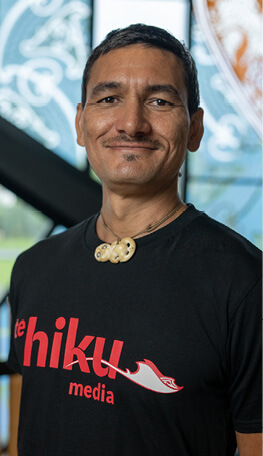
Since Keoni Mahelona first stepped foot in Aotearoa as a college student, the country and its vibrant Polynesian culture has shaped him. “It was like being at home,” he said. Both the Native Hawaiian and Māori cultures share strong beliefs around sovereignty. And both value protection over ownership.
Today, having lived in Aotearoa for more than 15 years, Mahelona speaks with a Kiwi lilt. He has made a good life for himself there: he fell in love with a Māori and together they’re raising a son, Nukumamao, who is both Māori and Kānaka Maoli. And he works at a Māori media organization, Te Hiku Media, helping to create tools designed through a native lens utilizing artificial intelligence (AI).
However, Hawaiʻi still calls to Mahelona, 40. He wants to serve his lāhui, too.
“I’ve always had – and still do have – that feeling,” Mahelona said. “It’s a kuleana, not a desire. I have a kuleana that tells me, that pulls me back, and it’s always been there.”
Mahelona originally hails from Anahola, Kauaʻi. He grew up in a house that his Kanaka Maoli father built with his own hands. Though it didn’t have electricity, it served as a roof over the heads of their ʻohana.
Mahelona remembers his dad and mom working hard to provide for their children. It fortified his resolve to pursue an education and change his family’s circumstances.
“Growing up, our school friends – who were often not Hawaiian – had nice houses and other nice things. Hawaiians often were the poor people,” Mahelona recalled.
Under his tūtū wahine’s matriarchy, the extended ʻohana would gather on an uncle’s homestead land: an agricultural lot received in 1985. There, the relatives would host parties, tending imu and saying pule before meals. On the ʻāina, Mahelona’s father grew maiʻa. “Dad had the best bananas on the island,” Mahelona said. His father also grew and sold flowers.
As part of the Hawaiian Renaissance generation, “my father was always strong in his Hawaiian identity,” Mahelona said. However, his father yearned to learn ʻōlelo Hawaiʻi which Mahelona’s tūtū kāne didn’t pass onto the next generation.
Mahelona inherited that longing for language. And sovereignty.
As a child, he dreamed of becoming a famous actor although his grandmother pictured him as a brain surgeon. Later, Mahelona aspired to be an astronaut before settling on engineering.
He graduated with honors from Kamehameha Schools Kapālama in 2003. From there he headed to Massachusetts’ Olin College of Engineering. The snow was easier to adjust to than the American culture. After studying abroad in Aotearoa, Mahelona earned a bachelor’s degree in mechanical engineering as part of Olin’s second graduating class.
He worked in Boston for a year, but Aotearoa continued to intrigue him. Upon receiving a Fulbright Program scholarship tied to computational nanotechnology, Mahelona returned to Aotearoa in 2009 to attend Victoria University of Wellington.
That same year, he met his partner, Peter-Lucas Kaaka Jones, at a barbecue. They lived together in Wellington for a couple of years before Mahelona earned his master’s degree in physics in 2011.
Although he had three university degrees, including one in business, Mahelona struggled to secure an engineering job. He remembers it as the first time that race played a role in his exclusion.
“I won’t say it was the main reason, but it was definitely there, no doubt,” he said.
Instead, Mahelona did yardwork, photography and consulting. He and Jones moved north where Jones’ parents resided. While Mahelona helped Jones’ dad on the farm, milking cows and planting kumara (sweet potatoes), Jones brainstormed on how to fix his new employer’s dismal financial situation.
Jones had been hired as the general manager at Te Hiku Media in 2012. Mahelona helped him analyze the organization’s negative finances and Jones successfully reversed course. Today, Te Hiku Media raises millions annually in funding.
Meanwhile, Mahelona was conducting water collection research. Later, he launched a smart water startup. Though it lasted only three months, he learned valuable lessons from the experience. In 2014, Mahelona was brought into the fold at Te Hiku Media after rebuilding its website.
Te Hiku Media’s radio station often conducted interviews about topical issues in the community before uploading them. However, the team didn’t want to hand their data over to American corporations like YouTube.
Instead, Te Hiku Media built its own digital platform – although it soon needed new technologies to enhance language access. With thousands of hours of native audio archives, transcription would require an unreasonable amount of time – so Mahelona began building AI geared toward te reo Māori (Māori language).
Eventually, the tech team expanded from one – Mahelona – to about 10 people. Today, as the organization’s chief technology officer, he’s spearheading campaigns for Indigenous people to share their voices, which, in turn, improves Te Hiku Media’s tools. To this end, in about 10 days some 2,500 people recorded more than 300 hours of audio.
This year, Te Hiku Media launched a similar campaign, the Lauleo Project, in Hawaiʻi.
This past February, about 1,200 people read sentences in ʻōlelo Hawaiʻi totaling 420 hours in just one week. “That’s an absurd amount of speech data,” Mahelona said.
Mahelona is driven to continue serving people back home, although he understands that, as a Hawaiian living overseas who doesn’t work in the Hawaiian community, he needs to build pilina.
Still, “I’m quite proud that the work that we’re doing is also going back to Hawaiʻi in a positive way,” he said.
For now, besides his career, Mahelona is focusing his energy on 1-year-old Nukumamao. And when he dreams of his keiki’s future, he hopes Hawaiʻi is in it.