
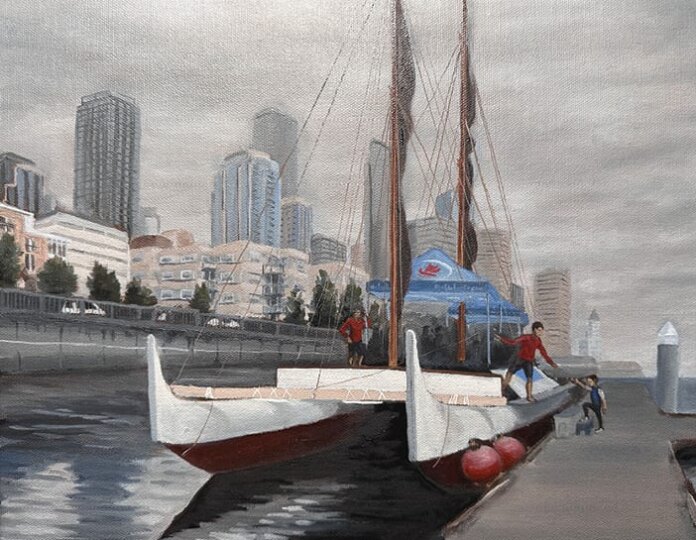
By Lehuauakea
Narratives of diaspora are nothing new to our community and culture. Growing up in Hawaiʻi, it is commonplace to learn about the first migrations that brought our kūpuna into Polynesia, to Tahiti, and on to the islands that many of us now call home.
We have stories of our own deities’ migratory paths that connect numerous islands across the Pacific. In many cases — whether it be our lineal human ancestors or akua — their migrations kept them on the move, often bringing them to distant lands beyond Hawaiʻi’s shores.
In post-contact histories, Chief Kaʻiana and a woman documented as “Winee” were the first Kānaka to sail abroad on Western vessels in 1787, following in the footsteps of their voyaging ancestors, seeking new places and experiences previously unknown to the Hawaiian people.
Sailing for months at a time, Kaʻiana and Winee accompanied their crews along transpacific trade routes to modern China, the Pacific Northwest Coast, and the Philippines. Their journeys would soon spark a movement of Hawaiians seeking opportunities abroad.
Relocation — temporary or permanent — of Native Hawaiians began in larger numbers in the early 1800s, primarily with young men seeking employment in the rapidly expanding Pacific Northwest economy. As their labor contracts expired, some returned home to Hawaiʻi while others remained in the region, establishing communities that stretched from Southern California to British Columbia and Alaska.
Markers of these early Kānaka remain in the form of place names and the present-day descendants of Native Hawaiian families who still reside near the original Kānaka settlements.
Today, Native Hawaiians continue this migration from Hawaiʻi to the Pacific Northwest, some leaving home for career or educational opportunities, planning to later return home.
Unfortunately, an overwhelming proportion of those living in the continental Native Hawaiian diaspora find themselves unable to afford moving back to Hawaiʻi. With decades of compounding socioeconomic factors resulting in the rising cost of living, limited employment opportunities, dispossession of family lands, and skyrocketing home prices, the average local Native Hawaiian family must do more to stay in Hawaiʻi.
A growing number of individuals and families simply can’t keep up with these mounting financial demands and are faced with the difficult reality of relocating to the continent to more feasibly afford a better quality of life.
As of 2020, over half of the total Native Hawaiian population now lives outside of Hawaiʻi for the first time in history.


These diasporic narratives serve as the focus of the new exhibition, “DISplace,” which opened at Seattle’s Wing Luke Museum on June 13. Co-curated by myself, and artist-educator Kanani Miyamoto, “DISplace” puts into context the multifaceted experiences of resilience and adversity within Native Hawaiian diaspora communities in the Pacific Northwest expressed through the work of 11 contemporary Hawaiian artists from Oregon and Washington, an in-depth historical narrative, recorded audio interviews, and loaned objects from community members.
By highlighting these stories as part of a continuous history, rather than a relatively new one, “DISplace” offers visibility to the diversity of diaspora experiences and the different factors behind relocation. It also touches on the highly nuanced stories of multigenerational displacement, such as those of individuals born on the continent.
Bringing our own experiences as Native Hawaiian artists with roots in both Hawaiʻi and on the continent, Kanani and I curated this exhibition with intention, inviting the Pacific Northwest community to tell their own stories of finding their voice despite the struggles of assimilation, challenges with cultural connection, and mixed identity.
Going into this project, I recognized the privilege in my background — being born in Portland, Oregon, yet raised between Oʻahu and Hawaiʻi Island and attending Kamehameha Schools before relocating back to Oregon as a teen.
Despite a childhood lived in multiple places, I was blessed to be raised around my culture and community, speaking ʻōlelo Hawaiʻi, dancing hula, and knowing my heritage. This is far from what is considered the ʻnorm’ of a contemporary Native Hawaiian diaspora experience, but it also made me wonder: What is the norm?
With many Hawaiians leaving for various reasons at different stages of life, some able to return to Hawaiʻi as adults, and others born second or even third generation away from their ancestral homelands, the experiences of those seeking, finding, and expressing connection to our culture are diverse and numerous.
Yet, we always find ways to maintain our connection to Hawaiʻi on the continent — through hālau hula, Hawaiian Civic Clubs, community māla (gardens), student groups, and relationships with family and community back home. Between kumu hula, community organizers, educators, and families now living in diaspora, many Hawaiians are doing important work to ensure proper representation of our culture in distant places while creating safe spaces for our communities abroad to remain connected to their cultural heritage.
As an alarming number of Kānaka face the difficult decision of relocation, it is important to consider diaspora on a spectrum. There is no “one-size-fits-all” approach to defining our lāhui who have been displaced or chose to leave to afford a better standard of living for themselves and their families.
At the same time, we recognize that Hawaiʻi is not the same without Kānaka Maoli. So, perhaps it is time for the lāhui still living on ʻāina to consider the ways that we can leave the door open for our diaspora community to begin moving back, and recognize that we are stronger together, no matter where we might call home.
A graduate of Pacific Northwest College of Art, Lehuauakea is an interdisciplinary artist and kapa practitioner who currently resides in Oregon.