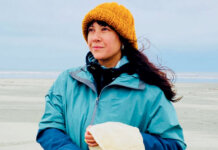
Maile Arvin is a Kanaka Maoli who finally came home.
A young Arvin once dreamed of growing up to be a marine biologist in the hopes that it would take her back to Hawaiʻi – the place where she spent her childhood summers in Waimānalo at her tūtū’s homestead, playing hide-and-seek among the plumeria trees with her cousins and walking to the 7-Eleven down the street for snacks.
Ultimately, Arvin’s career path pivoted to academia which recently lead her to accept a job as an assistant professor in ethnic studies and public administration at the University of Hawaiʻi at Mānoa.
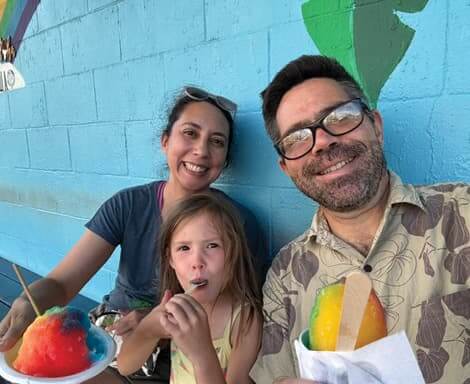
Arvin, 42, spent most of her life in the Hawaiian diaspora. Now, she is raising her 6-year-old daughter, Lilinoe, on the ʻāina.
“Having a lived experience and a connection to Hawaiʻi made a huge difference,” Arvin said.
Arvin was born in Lexington, Kentucky – the land of her white paternal ancestors, who worked with their hands as farmers and factory workers in America’s rural pockets.
Her father, Tracy, served in the U.S. Air Force during the Vietnam War and was later stationed at Bellows Air Force Station in Waimānalo. Her mother, Wanda, a local girl from Waimānalo, worked there at the snack bar. The couple met, fell in love, moved to Kentucky in the 1970s, and got married.
Wanda’s ancestry is a blend of ʻŌiwi, Chinese and Haole, although her ʻohana most strongly identified with their Kānaka Maoli lineage. Wanda and her four siblings belonged to a generation that was given Christian first names, so they felt compelled to give their own children Hawaiian names.
“She imbued in me as a young kid [the understanding] that Hawaiʻi was really special and that it’s really special to be Hawaiian,” Arvin said.
Arvin, an only child, was raised in the college town of Richmond, Kentucky. She described the small city as largely segregated into Black and white in the 1980s.
“I always knew I was different,” Arvin said. “There wasn’t a lot of language or understanding around where (my) Hawaiian side fit in that white/Black binary.”
There was also a lack of discourse around the Hawaiian diaspora. Arvin, who was very shy, found it difficult to correct her teachers when they didn’t take the time to learn how to pronounce her name. Still, she always enjoyed, and excelled at, academics.
At 14 years old, Arvin was struck by tragedy when her father passed away after a fight with colon cancer. She and her mother moved to Oʻahu one year later.
Arvin attended Punahou School for her last two years of high school. The private college prep school experience struck her as “intense” – not the academics but the social scene. “I never met so many rich kids my whole life,” she laughed.
Arvin graduated in 2001. Soon after, chasing her independence, she was back on the continent at Swarthmore College in Pennsylvania. An English major and history minor, Arvin remembers taking courses on utopias and fascist Europe and frequenting a Korean neighborhood in nearby Philadelphia for dinners with her dormitory friends.
In an Asian American history course, she was particularly excited for a section on Hawaiʻi, with her copy of Haunani Kay-Trask’s Lovely Hula Hands marked up in preparation – only for the discussion to be dominated by a white male student offended by the Hawaiian activist’s ideas.
It made an impression on Arvin as a future teacher.
She earned her bachelor’s degree in 2005, then moved to San Francisco, California, and worked at the Asian and Pacific Islander Wellness Center, a nonprofit focused on HIV/AIDS in those communities.
Arvin knew she wanted to go to graduate school and felt pulled to focus her studies on race in Hawaiʻi. That brought her to the ethnic studies program at the University of California, San Diego, in 2007. Propelled by her love for reading, writing and research, Arvin wrote her dissertation on race in the Pacific and prepared for a career as a professor.
She earned a master’s degree in 2009 and a Ph.D. in 2013. “I kind of found my voice more in graduate school,” she said.
There, she also met her husband, Ryan Moran. The couple married in 2011.
Arvin completed her postdoctoral fellowship in the UC system and took her first faculty job at the University of California, Riverside. She served as an assistant professor in ethnic studies from 2015 to 2017. Arvin recalls teaching a lecture on Native American studies in a repurposed commercial movie theatre.
She was then hired by the University of Utah to help build its new Pacific Island studies program after the university’s local Polynesian community pushed for it. Arvin worked as an assistant professor of history and gender studies there from 2017 through 2022.
Her book, Possessing Polynesians: The Science of Settler Colonial Whiteness in Hawaiʻi and Oceania, was published in 2019. It marked a significant year for Arvin; it was also the year that her daughter, Lilinoe, was born.
In 2022, Arvin became the program’s director and an associate professor of gender studies. Arvin helped the program evolve into the Center for Pasifika Indigenous Knowledges. She took on the role of director in 2024.
But in Utah, “the political climate made a lot of our work really difficult,” Arvin said. “That’s what made me start to really want to be back in Hawaiʻi and to apply for the job here.”
It was the catalyst for her move to Honolulu this past June.
She’s now turned her attention to her current research project, Nā Lei Poina ʻOle, which is the basis of her upcoming second book about the history of reformatories and industrial schools in Hawaiʻi.
Arvin is also resettling into her ancestral homeland.
“Adjusting to a new place and a new stage in your life can be stressful, but I think it’s a great privilege,” Arvin said. “I’m just really happy to be here. I’m really happy that I can continue the work I’m doing.”