

When researcher Kuʻulei Rodgers started working at the Hawaiʻi Institute for Marine Biology (HIMB) back in 1992, hardly anyone had heard of coral bleaching, a stress response that causes corals to lose their color.
But just four years later, Hawaiʻi had its first documented widespread coral bleaching event, which affected reefs in Kāneʻohe, Kailua and Waimānalo.
A decade later, two major coral bleaching events happened in 2014 and 2015, bleaching more than half of all corals statewide and leading up to a 30% loss. In Kāne- ʻohe Bay alone it was observed that 80% of the coral had been bleached white.
Once a phenomenon predicted to happen every 50 years, coral bleaching episodes, triggered in part by heat waves, are now expected about every six years.
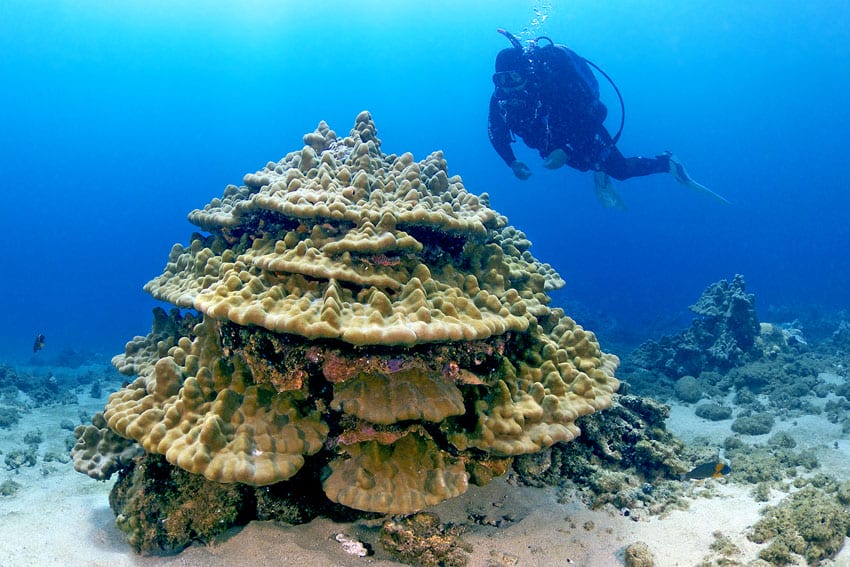


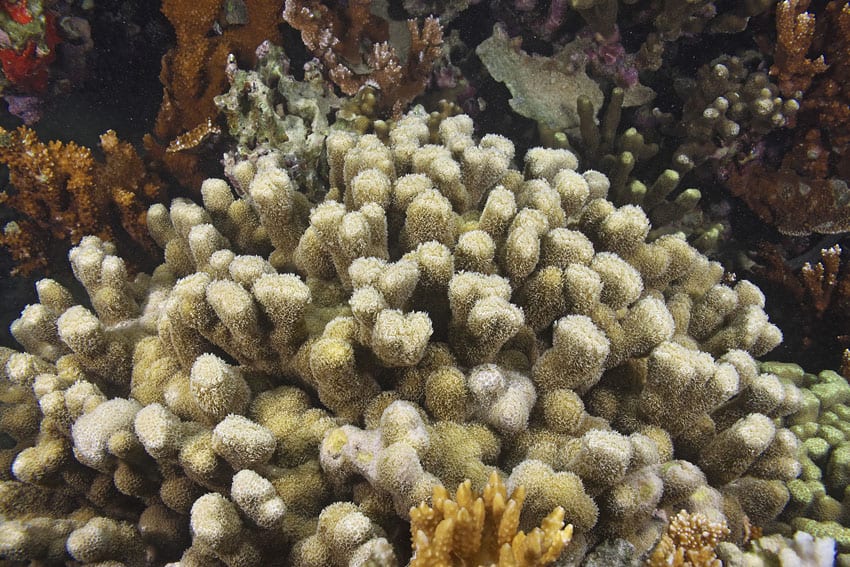
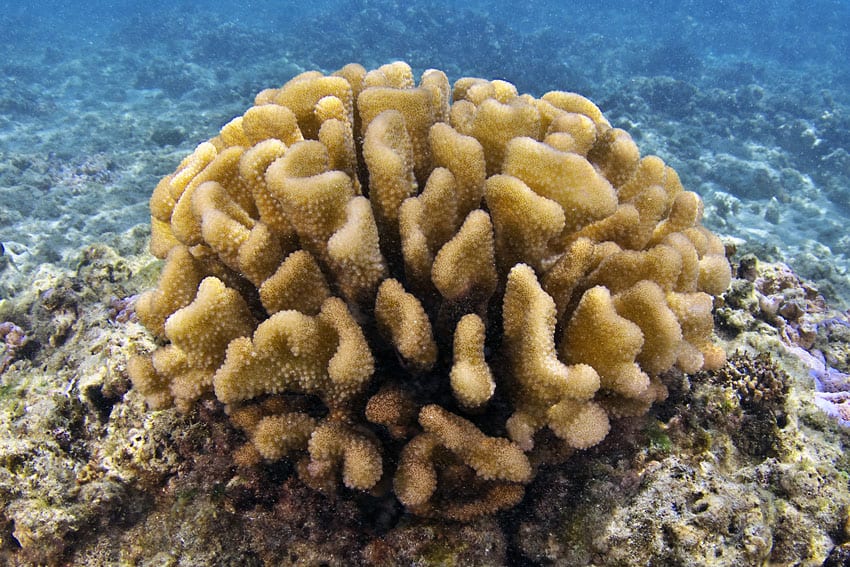


Researchers and resource managers now know more than they did a decade ago about why some corals seem more resilient in the face of increased stress. What they’ve learned has led to positive changes in coastal management, scientific advancements and the implementation of novel approaches – all aimed at giving corals a better chance of survival.
“We’re at a very pivotal place right now in history where the decisions we make today, and especially this decade, are going to determine the direction of the future of our reefs. It’s gotten that bad,” said Rodgers, who recently retired from HIMB. “We’ve already lost over half of the world’s coral reefs. But the good news is that we still have half of the coral reefs – and many of them are in Hawaiʻi.”
Coral bleaching happens when corals expel symbiotic algae from their tissues as a stress response to environmental factors, including increased ocean temperatures.
But many Hawaiian corals also uptake zooplankton from the water as another source of nutrients, said Rodgers. These species of corals have lower mortality rates than others. Prolonged coral bleaching can cause die offs of coral colonies, which form the foundation of all marine life.
In 2015, the Hawaiʻi Coral Bleaching Collaborative (HCBC) was formed to create a system and network through which coral reefs could be rapidly surveyed following bleaching events.
“Hawaiʻi has stood out across the world as being one of the more coordinated places. We’ve had inquiries from all over the world, asking us how we’ve been so successful. The reason why is because we came together under the HCBC,” said HCBC Coordinator Mary Donovan who joined HIMB last year as an assistant researcher.
The surveys are triggered when members of the collaborative receive notification from the National Oceanic and Atmospheric Administration (NOAA) about an impending heat wave or a prolonged period of above- average water temperatures.
Heat waves in Hawaiʻi typically occur during the warmest months, usually starting in August and ending by December. Donovan said a prominent study has shown that heat waves are becoming more frequent and longer lasting.
Donovan’s lab team also leads the Hawaiʻi Monitoring and Reporting Collaborative (HIMARC), which combines data from various surveys to produce maps and graphs about coral reef health for decision makers.
The latest data shows pollution, particularly from waste disposal, weakens corals’ ability to survive heat stress. The presence of herbivorous fish, such as uhu, kala, and nenue, help maintain the balance between corals and algae.
Areas with pollution and low populations of herbivores can be overgrown with algae that suffocate coral reefs and make them less likely to survive bleaching events. Donovan’s team is working on a statewide analysis on the variability of coral reef health related to these environmental factors.
“There’s still a lot we can do, even as we have climate change causing these really devastating events to happen,” said Donovan. “We can work together to decrease the pollution that gets into the ocean and fish in a pono way.”
Donovan said progress has been made, especially in the past 10 years. “I want to give credit to DAR (the Division of Aquatic Resources under the Department of Land and Natural Resources) for the work they’re doing with the community to develop rules and other actions that will help us in the next bleaching event.”
DAR set a goal of “sustainably managing herbivore populations through responsible harvesting practices in order to promote coral reef resilience.” In February 2024, after a years-long public process, resource managers adopted new fishing rules that increased the minimum size required to harvest certain herbivore species important to coral reef health.
The restoration of corals lost during recent bleaching events also became the highest priority in DAR’s plans related to coral bleaching. Specifically, the “Makai Restoration Plan” updated in April 2023 has set a goal to “build capacity to develop, test, and apply restoration methods that enhance the resistance and recovery of coral reefs impacted by bleaching.”
Fourteen potential areas that had experienced severe impacts to coral communities during bleaching events were identified in the plan. These include the Leeward side of Maui, North and South Kona and South Kohala on the island of Hawaiʻi and Kāneʻohe Bay, Lanikai and Waiʻalae-Kahala on Oʻahu.
Beyond management actions, scientists are also looking at ways to support coral restoration efforts through technological advancements. One example comes from Smithsonian Institution researcher, Mary Hagedorn, whose lab at HIMB is studying viable ways to save coral egg and sperm through cryopreservation or freezing. “If these corals are lost, at least there is still something that can help them, like having a bank for reproduction,” said Rodgers.
Last year, Hagedorn and other researchers from Harvard Medical School, National Ecological Observatory Network, University Corporation of Atmospheric Research, and the University of Minnesota published a paper in BioScience exploring the idea of creating a passive lunar biorepository – cryogenic preservation of biological material on the moon – to safeguard Earth’s biodiversity.



%20back%20in%201992,%20hardly%20anyone%20had%20heard%20of%20coral%20bleaching,%20a%20stress%20response%20that%20causes%20corals%20to%20lose%20their%20color.)