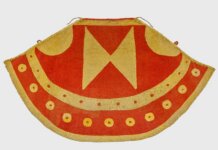
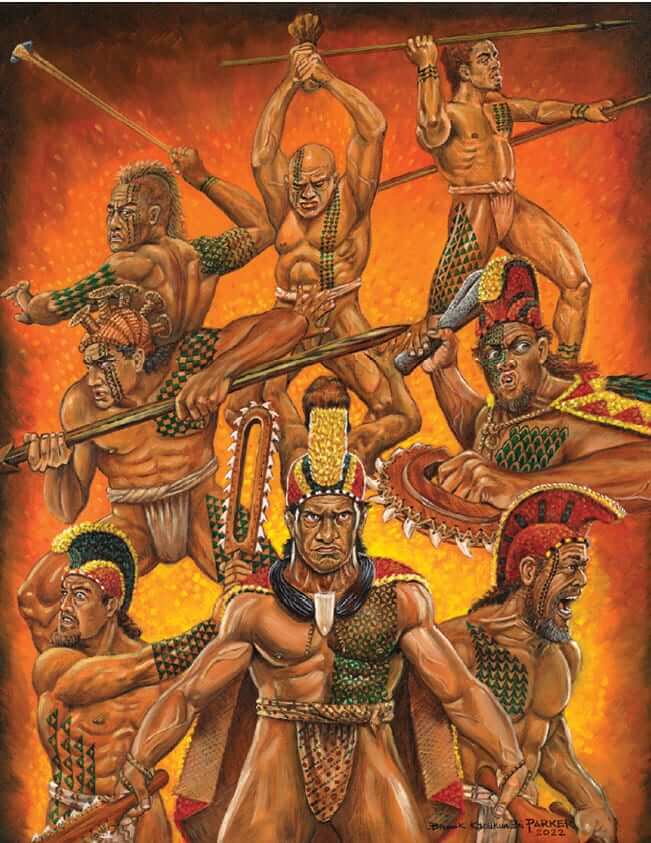
We launch from Molokaʻi. Three mano (12,000) of warriors. Hundreds of war canoes, with the biggest carrying cannons and muskets. Two schooners join us offshore – I see Young and Davis on deck with a brass cannon between them. I love the sound of hulls and paddles on water. I wear a yellow-feathered helmet, a coconut fiber battle cape, and boar tusk wrist guards.
My men know an army twice our size awaits. They show no fear. Canoes from Maui join us halfway through the channel. It is as if a chunk of Molokaʻi broke off to form a new island that moves toward Oʻahu. The southeast tip of Oʻahu is walled with cliffs. Black ledges rise above the sea. Our landing will be the shoreline of Waikīkī. A whale surfaces, showering us with seawater from its blowhole.
We reach Waikīkī. It is strangely quiet. No sign of Oʻahu’s kupa, aside from an ʻohana of fisher folk. My war canoe flies through the shallows and glides up a mud bank.
My warriors unload cannons and muskets. I have the canoe booms removed and its hull turned upside. The paddles are gathered and stored in a hold, to discourage the fearful from fleeing. My scouts return. They report enemy warriors massing in the Nuʻuanu highlands, where cliffs are notched for cannons. Kaʻiana, my rival from Kauaʻi, has joined them. I suffer knowing I must kill the man I once loved as a brother.
We camp between a coconut grove and the crater wall, awaiting attack. No attack comes. We rest three days in Waikīkī. My men grow anxious. Skirmishes break out. Makaʻāinana women have made the crossing with us. Some are the wives of warriors. One belongs to Young. They make us simple meals of fish and poi. They serve the soft flesh of ʻulu, ʻuala, and maiʻa. Some in my army only eat breadfruit, banana, and sweet potato. A few suck on the sugary stalks of kō.
Young and Davis make ammunition for the cannons by wrapping river stones in kapa bundles. I have entrusted the aliʻi wāhine with muskets. These royal women practice firing and loading on a field beneath the crater.
It is difficult for me to eat. I find it harder to sleep. The wind rattles the coconut fronds and strange birds cry out in the light of a crescent moon, as if dying.
Day four in Waikīkī. Anger moves like waves through my army. They are anxious. Two low chiefs from Kona test stone clubs against the trunks of kiawe trees. Their blows sound like drumbeats. The time to make war has come. We march north over mud flats and follow a river through fields of kiawe. I carry the sacred ax ʻOlopū, made from the green stone of Kauaʻi.
A column of my tested koa (warriors) follow a river meandering toward a crater smaller than Lēʻahi. These small volcanoes are dangerous. Enemy warriors may charge from either or both sides, destroying formations and denying the chance to fire cannons and muskets.
We reach the base of the crater. The pū kaua blows. This war trumpet is the voice that chills the coward to the bone. An enemy crescent skirts its edge, blocking our advance. Black war dogs roam the plain between armies. It is time.
“Makawalu,” I order my men. Brush formation. Two small forces break from my army to take up positions right and left. They will protect our flanks against surprise attacks. Davis and Young position the cannons. I share the ʻawa bowl with my fellow aliʻi. I drink deeply. The calm comes.
Across from us on the battlefield Oʻahu’s warriors pass the ʻawa bowl too. The ʻawa steadies my hands and makes my feet feel part of the earth, as if I have risen from the lava pulsing with fierce blood.
Oʻahu’s warriors rattle their spears and clubs. The dogs flee. The deadly hum of slings comes, filling the sky with pōhaku. Stones pelt us, cutting open skin and cracking gourd helmets. I order our ihe (spear) men forward while my maʻa warriors sling back pōhaku. They hurl spears – dagger tips strike my front line and men fall.
I spot Kaʻiana raising his musket and firing. I signal my Haoles. Young pours in black powder and Davis lights the fuse. Lōpaka booms. Flying stones cut through the enemy crescent. The smaller cannons fire. Second and third volleys shatter their crescent into pieces. A black fog from the firing cannons drifts over the battlefield. Kaʻiana urges his men on, leading a swarm into our teeth of my army.
The aliʻi fire their muskets, knocking Kaʻiana off his feet. Kaʻiana struggles to stand. Again, our muskets fire. Kaʻiana drops. Keʻeaumoku presses the front wall of pololū (long) spears forward. The two smaller forces unite to attack from the west.
Oʻahu’s army is trapped. Many stand their ground and fight hand-to-hand. Some run into the foothills. I know the trail they take north will lead us to my half-brother. This first battle was only a skirmish. Kekūhaupiʻo carries Kaʻiana’s body to the crater and places it on a ledge. Tomorrow I will bury my enemy and my friend. Perhaps he believed he would take my life today and send my men back to Kona.