
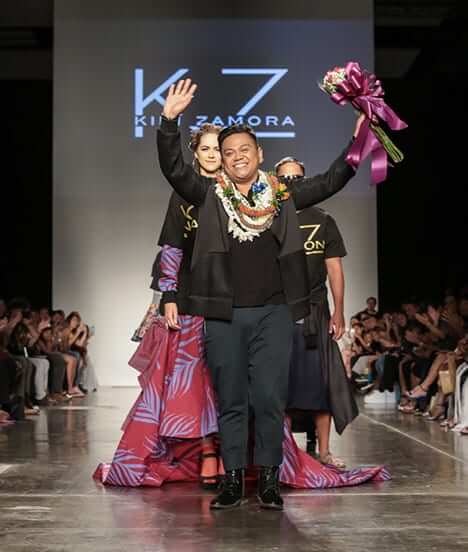
Kiniokahokuloa Zamora’s success as a fashion designer is a story about the power of ʻohana.
Perhaps his parents sensed he was destined for greatness, and this inspired his name, which means “king of the morning star.”
Today, he is known simply as Kini Zamora, the designer who has established the eponymous fashion house recognized locally and globally.
In 2015, Zamora became a household name virtually overnight after representing Hawaiʻi on the reality TV show, Project Runway.
Zamora was 10 years old when his Aunty Delilah offered to give him and his cousins their first sewing lesson. It was pivotal experience; Zamora was hooked. His aunty had learned to sew from Zamora’s grandfather and was passing on this sewing expertise to the next generation.
“I was the only one who wanted to learn more,” Zamora remembered. “My mom gave me sketch pads because I liked to draw, to create. She always knew I had that in me. Sewing was a medium to express myself, to bring my sketches to life. I would design clothes for troll dolls and dress them up.”
His ʻohana encouraged his passion for sewing. “I always received fabric for Christmas, and I enjoyed sewing all my own clothes,” he said. “I designed and wore jams shorts to school. My aunty showed me how to construct from a commercial pattern and how to piece things together from a design perspective.”
Zamora also sewed for others. One of his proudest achievements was creating a customized tank top for his mom; it was the first gift he made.
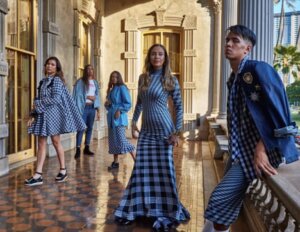
Despite learning to design and sew from his aunty, Zamora wanted to formalize his knowledge with a degree in fashion technology from Honolulu Community College (HCC).
His parents were unable to financially support his college aspirations, so Zamora applied for college financial aid, obtaining scholarship assistance from Kamehameha Schools, the Rotary Club, and other organizations plus additional financial support from HCC as a male in a female-dominated field of study.
After graduating from HCC, Zamora applied, and was accepted, to the prestigious New York Fashion Institute of Technology (FIT). However, he quickly found the classes too basic.
He stuck it out for more than a year, but eventually decided it was not worth his time or money and returned home to Hawaiʻi. Nevertheless, he enjoyed the experience of living in New York City.
When Zamora was selected to compete in Project Runway, it set a new trajectory for his fledgling business. “I applied six times over a 10-year period before finally being selected,” he said. It is that kind of resilience that has fueled his success.
He participated in extensive interviews and even a psychiatric evaluation designed to ensure that the “cast members” could handle the sometimes-brutal critique from celebrity judges and compete with other talented, ambitious contestants.
“It was excruciating,” he said.
He made it through the initial application process and was flown to Los Angeles for open casting before a panel of judges. Upon returning home, he submitted a video, a work portfolio, and participated in an on-camera interview.
Once he was selected as a finalist, Zamora had just five days to get to New York City. Finalists were not introduced to each other or allowed to interact. The show was filmed at 8:00 p.m. and by 7:00 a.m. the following morning he was on a plane returning to Hawaiʻi.
After learning he was selected for the show, he was not allowed to tell anyone why he would be away for six weeks. “But I think everyone knew,” he said.
The exposure Zamora received from being on Project Runway, super-charged his business. He suddenly had to curate work requests to ensure he could keep up with the demand. It was a good problem to have.
And the feedback Zamora received from the judges on the show helped to hone his design aesthetic. He specializes in two areas: avant-garde creations and ready-to-wear.
His avant-garde creations are often “over-the-top” pieces created for weddings, pageants and for performing artists, including hula hālau. “It’s always gratifying to see your work on stage,” he grinned.
His ready-to-wear clothing is the company’s signature Hawaiʻi lifestyle brand. Each year, he produces four or five collections, each with 20-60 mix-and-match design options sold primarily through the company’s website and at Noʻeau Design in Kapolei. He would eventually like to elevate Kini Zamora into a lifestyle brand and expand into eyewear, accessories, fragrance, and home furnishings.
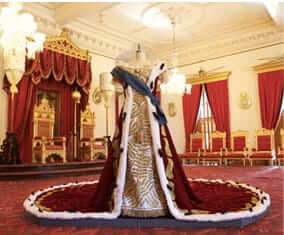
Zamora also has contracts to produce aloha wear uniforms for organizations like ʻIolani Palace, Maryknoll School and St. Louis School and he hopes to scale up his business to serve bigger uniform contracts.
To help expand his business, Zamora secured an Office of Hawaiian Affairs Native Hawaiian Revolving Loan Fund loan.
His team is currently composed of five part-time employees and sub-contractors who are committed to making work fun, interesting and creative. And he offers design internships to college students.
Zamora is also trying to run an environmentally responsible business. “The fashion industry is the second most polluting industry (in terms of waste),” he notes.
Walking his talk, the company is taking steps to be more sustainable. Zamora participated in the first two “Goodwill Goes Glam” shows, which encourages reducing, reusing, recycling, and upcycling used clothes and accessories. His company packages online orders with minimalism in mind and also offers pick-up options. Paper from sublimination printing is recycled to create patterns or as wrapping paper, while fabric remnants are donated to H&M’s recycling program for reuse.
Today, from his studio in Hālawa, Zamora and his team continue to create enduring designs and dream even bigger dreams for the future of the business.