
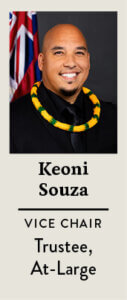
Mana is not just spiritual energy – it is identity, it is lineage, it is the invisible thread that ties us to our kūpuna and ʻāina. For me, music is my mana.
Traditional Hawaiian music has never been just the streaming background ambience at a party or a pleasant pastime. It is my power source – a vessel of memory, emotion, and resistance. It reminds me of who I am, where I come from, and why I must carry these stories forward.
Every mele inoa is a genealogy, a way to honor someone’s life and legacy. Every mele ʻāina expresses gratitude to our sacred places. Every oli echoes the breath of our kūpuna. These aren’t just performances. They’re offerings. They are acts of devotion and remembrance, strung together by kaona, by pilina, by aloha.
In my work at the Office of Hawaiian Affairs (OHA), you’ve likely noticed I often refer to mele. I do this intentionally. It’s how I connect, how I process, and how I lead. I don’t just hear mele – I live through it. It shapes my values, my decisions, and my understanding of ʻāina and people.
Growing up, mele was everywhere. At family pāʻina, birthdays, or lūʻau someone always had a guitar or ʻukulele in hand, and voices joined together naturally, without needing a stage or spotlight.
Today, I see a shift. Playlists have replaced kanikapila. We listen more than we sing. And while technology has helped us preserve old recordings, it has also created distance between us and the act of making music together. What once was a shared language is at risk of becoming just a special event.
This is why the kuleana we hold at OHA goes beyond budgets and policies. It includes nurturing the ways of life that sustain our people. That means uplifting those who carry the torch of mele – the composers, chanters, kumu hula, and musicians who teach us to remember.
Organizations like Merrie Monarch, the Hawaiʻi Academy of Recording Arts, the Hawaiian Music Hall of Fame, and the Hawaiian Music Perpetuation Society are not just cultural institutions – they are guardians of mana.
Through my musical group, Nā Hoa, I’ve seen how traditional Hawaiian music can restore pride, spark identity, and awaken the soul. I’ve witnessed ‘ohana weep while singing nā mele kūpuna. I’ve seen keiki stand taller after learning an oli. This is not entertainment. This is healing. This is transformation. This is mana.
We need to continue to return mele to its rightful place – in our homes, in our classrooms, in our everyday lives. We must make it easy and natural to sing. That’s why I will always support initiatives that prioritize mele. I believe it is our kuleana as OHA trustees to ensure that funding reaches those who protect this legacy. I’ve been working to initiate some ways to support mele even further:
- Supporting mele workshops in every moku, led by kūpuna and other local musicians.
- Funding archives to preserve rare and endangered songs.
- Offering grants to those who wish to record their own mele and moʻolelo.
- Embedding traditional music and ʻōlelo Hawaiʻi into keiki education.
This is not just preservation – this is breath. This is life. And when we lift our voices together, teach our keiki, and honor the wisdom of our kūpuna, we do more than survive – we thrive.
Let ours be the generation that remembers. Let us be the lei that binds past to future – one note, one mele at a time. Because for me, and for many others, music is not a pastime. Music is our mana.

