
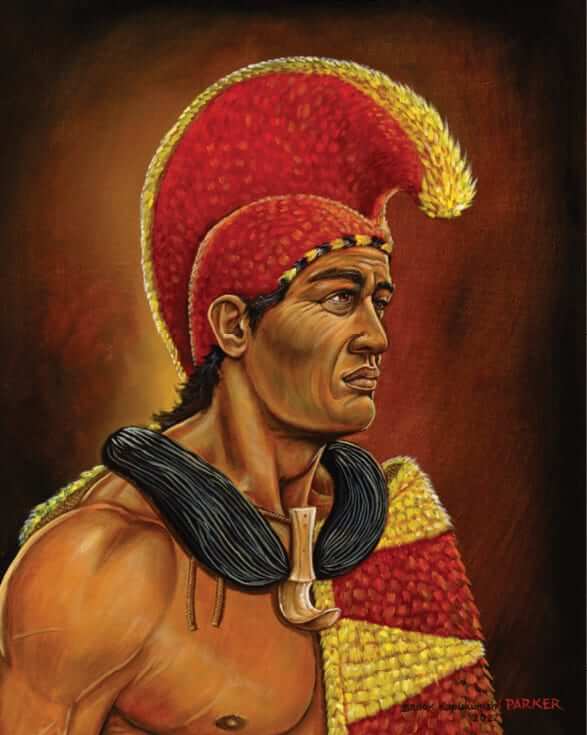
– Image Courtesy of Brook Parker (hawaiianatart.org)
By Kainoa Horcajo
We cannot discuss Kamehameha – the man, the chief, the king, the legend, without mentioning the circumstances surrounding his birth, the world he was born into, and the stories that would slowly but inexorably be drawn into his gravity.
Like any story of a legendary figure, additions and exaggerations can be expected. This is doubled by the fact that he was born before Western arrival, at a time that was not counted in years from Christ’s death by a culture that at that time did not put pen to paper. But there is a kernel of truth in every story, and we can be sure our oral accounts, our mele, oli, and moʻolelo carry with them facts and truths that are undeniable.
First came the prophecy. Kamehameha’s birth was said to have been heralded by a bright new star with the tail of a bird streaking across the sky. Halley’s comet, appearing in 1758, was surely quite a sight. The high priests interpreted the omen as marking the birth of a chief who would be a killer of chiefs, a threat to those currently in power. The decree came that such a child be put to death.
Born in the middle of a furious thunderstorm, the newborn was pushed through the side of the thatched hut and rushed many miles across the countryside to be raised in secret among commoners in a little fishing village in a remote part of Hawaiʻi Island.
After that jealous chief’s passing, young Kamehameha was brought back into the royal retinue to be raised alongside the other young chiefs of the island, learning all the skills that could be learned. Early on he demonstrated his natural talents in hand-to-hand combat, strategy, speed, strength, and wits.
Stories of his growing strength and rising influence abound. Surrounded by older chiefs, prophecy, and rising tides of power, Kamehameha was emboldened to demonstrate his mana. In front of a crowd of onlookers, he lifted and overturned the massive 5,000-pound Naha Stone, long said to be the sign of the one who would unite the islands under one rule.
Looking backward, the arc of his life can seem predetermined. But he was not the highest-ranking chief by bloodline. He was not the heir apparent. What followed was not guaranteed. The belief that he could do what had never been done was shaped by who he was, the people surrounding him, and the world in which he lived.
The story of Kamehameha is a lesson in Hawaiian thought. It is a reminder to believe in the ability to bend the universe to one’s will. Through physical, mental, emotional, and spiritual discipline, and the appropriate application of mana, the greatest among us tap into the riptides of reality and pull what is needed into being. Prophecies exist, but they do not fulfill themselves.
Kamehameha was likely happiest when fishing, farming kalo, surfing his favorite breaks, and enjoying the simple rhythms of life – up with the sun, sweating at work, smiling and laughing in play, circled around the fire with loved ones at night. This is how he spent his final years after uniting the islands. It’s also the life he lived as a child raised in secret. But like many great leaders, he made the difficult decision to walk away from that life to serve something larger.
The ancient world he lived in was both idyllic and brutal. Ruling chiefly families were engaged in a generational game of thrones, periods of peace broken by war, each reign vulnerable to the temperament of the chief in power. All it took was one leader obsessed with revenge or wealth to bring misery to thousands.
Many aliʻi over the centuries had seen the vision that uniting all the islands under one rule would bring peace, security, and wellbeing to the people. Kamehameha understood this deeply. Prophecy, preparation, and the counsel of trusted peers convinced him that he held the best chance of making it real.
He gave up the quiet life he loved, knowing the path ahead would be full of struggle. And he knew what kind of message he needed to give his people to prepare them.
“Imua e nā pokiʻi, a inu i ka wai ʻawaʻawa. ʻAʻohe hope e hoʻi mai ai.” Forward, my brothers and sisters, and drink of the bitter waters of battle. There is no turning back.
The rally before war was not about easy victory. It was a solemn acknowledgment of what lay ahead…pain, sacrifice, difficulty, and uncertainty, and the necessity of continuing anyway.
Avoiding adversity only leads to more of it. Kamehameha understood that refusing the burden would lead to future generations bearing the cost. Instead, he stepped forward. He drank the bitter waters.
His story is too often remembered from the mountaintop, as the king who ruled. But his legacy was built in the valleys, in the struggle, in the years of preparation, in the small daily choices he made long before any crown.
We officially celebrate our first king on June 11 but there are reminders of the kingdom he built for us every day. By uniting the islands, he laid the foundation for a Hawaiian-led government that resisted colonial domination for nearly a century. He established a kingdom, named an heir, and stayed rooted in traditional beliefs even as others around him turned to the new ways of the missionaries.
And when the time came, he did not seem interested in how he would be remembered. He had done what he had come to do.
In his final moments, he is said to have uttered: “E ʻoni wale nō ʻoukou i kuʻu pono ʻaʻole e pau.”
Continue the good that I have done, for it is not yet finished.
Others translate it as: Endless is the good I have given. Carry on my work. The meaning has been reinterpreted countless ways, adapted into slogans, prayers, and political messaging.
What often goes unmentioned are the words he reportedly said just before that, when asked for some final statement by a badgering chief he supposedly chided, “Why are you giving commands?! For what purpose?”
As he took his final breaths, he knew it was no longer up to him, his words, or his actions. He had already spoken. Already ruled. Already built. Already acted. He left behind a system, a succession, and a kingdom. The rest was no longer up to him.
The work had been done.
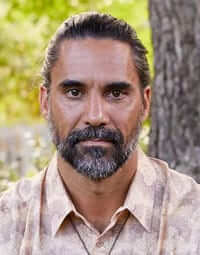
Kainoa Horcajo is a writer, speaker, storyweaver, cultural practitioner, steward of his ʻohana’s regenerative farm in ʻĪao Valley on Maui, and principal owner of The Moʻolelo Group, a multidisciplinary consultancy. To read more, subscribe to his digital newsletter, “Think Hawaiian.”