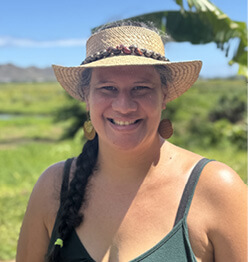
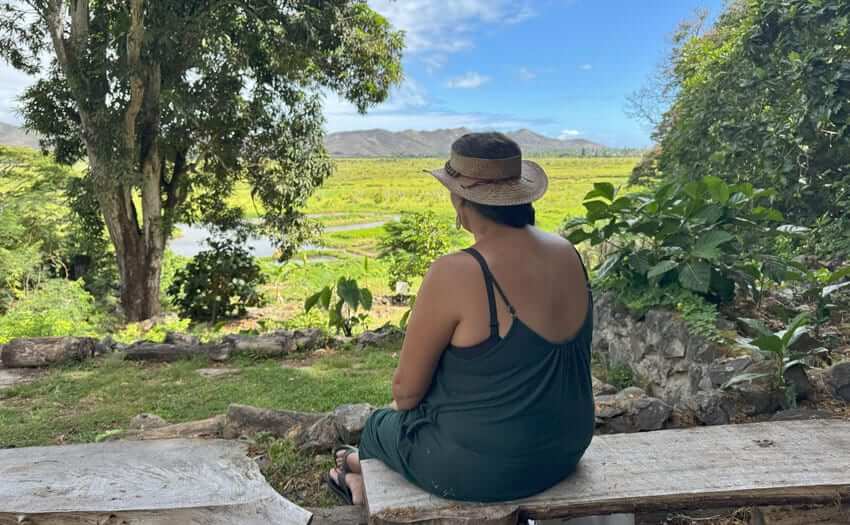
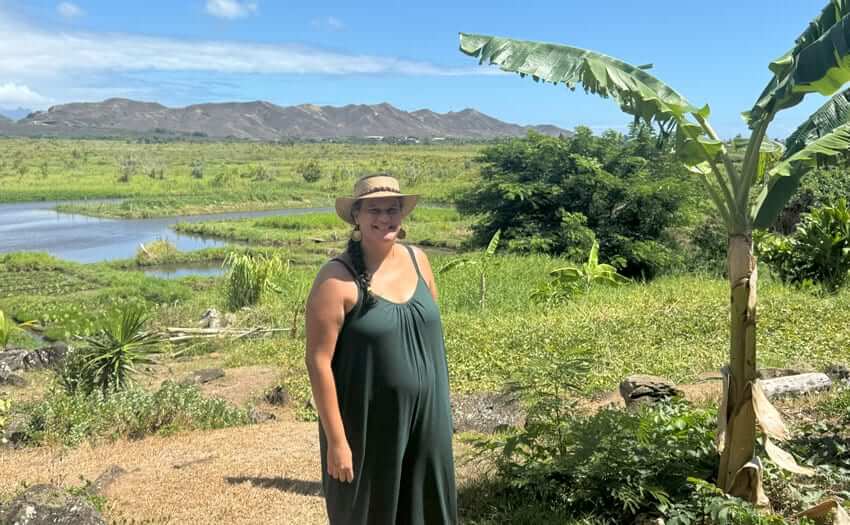
Just past Ulupō Heiau, Dr. Kiana Frank sits on a bench that provides a serene view of Kawainui Marsh. She immediately recalls a moʻolelo of this wahi pana that once flourished as a large fishpond – and the people who had influence over the area.
”It’s a really long story, but it’s basically about all these layers of what does leadership really mean? What does pono look like on ʻāina? And how do we make sure that we’re acknowledging our akua? Because that was the step that was missing – they were missing the acknowledgement of the unseen,” Frank mused.
As she gazes out at Kawainui, she continues the story of a young Kahinihiniula who was given a Mākalei branch linked to the goddess Haumea. Kahinihiniula used the branch to attract fish in Kawainui after he had been overlooked.
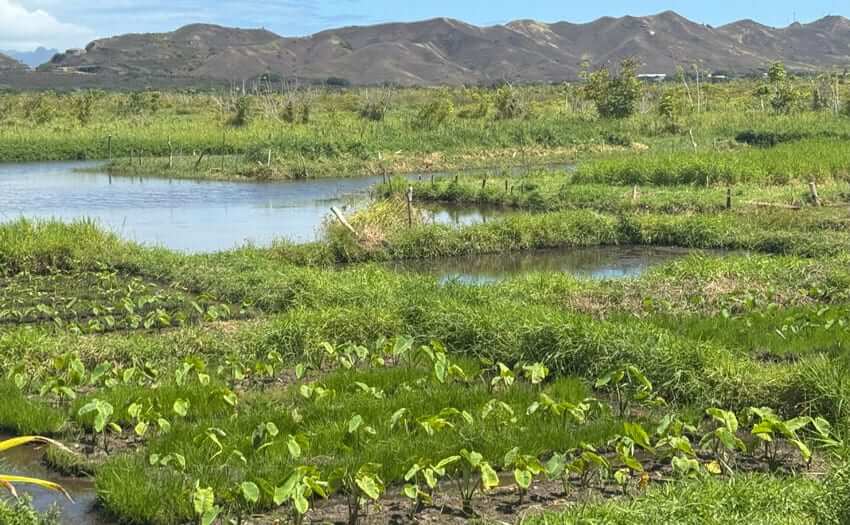
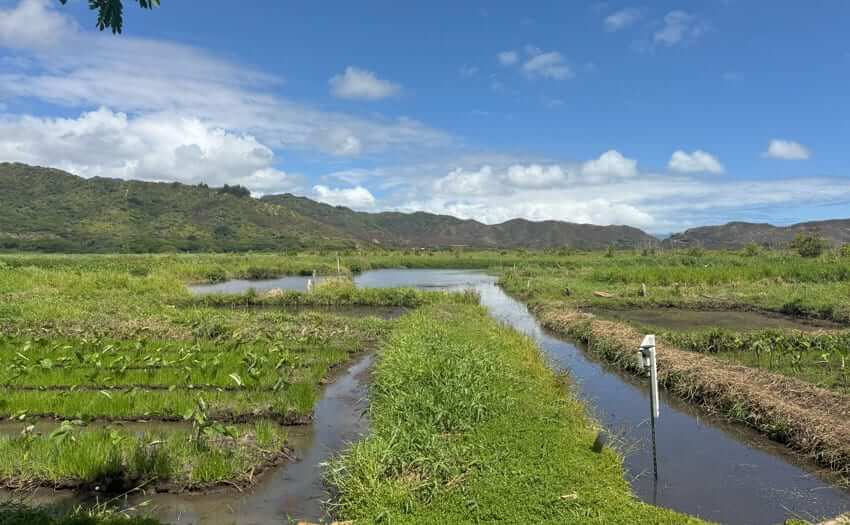
In 2007, Oʻahu’s Kawainui Marsh in Kailua was officially designated as a State Wildlife Sanctuary. It is mostly covered with layers of sedge.
Frank shares moʻolelo of this once thriving loko iʻa to help keiki and ʻŌiwi understand what was once here – and to envision what might one day be restored.
For the past five years, restoration of a small portion of Kawainui that includes Ulupō Heiau has been taking place through a stewardship agreement with the Department of Land and Natural Resources and Kauluakalana, a community nonprofit.
Clearing of sedge has led to the return of native birds. As for the fish, Frank notes they are invasive species that feed off the mud.
Kawainui has always been a place of wonder for Frank who grew up nearby – she can point out her grandmother’s house among others along its perimeter. It was her grandmother who told her a moʻolelo of the “edible mud.” Her curiosity led her on an academic journey from the marsh into the laboratory.
After graduating from Kamehameha Schools in 2004, Frank earned a bachelor of science degree in molecular genetics from the University of Rochester. She then attended Harvard University where she earned a master’s and Ph.D. in molecular cell biology.
Woven throughout her educational path was cultural inspiration found in working with Paepae O Heʻeia and its restoration of an ancient fishpond. She attributes cultural practitioners who have done, and are doing, the work in ʻāina among her most influential teachers.
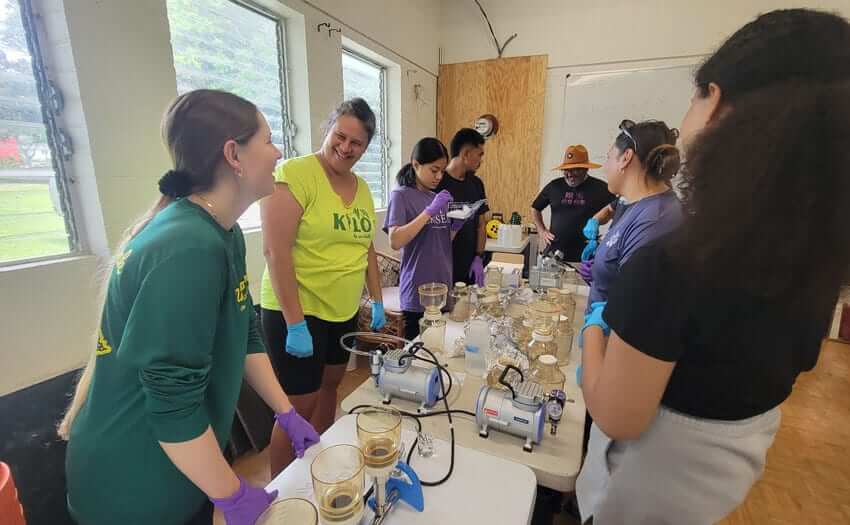
Her work on the ʻāina, paired with her academic training, gives her a formidable combination of skills that she brings to her work as an associate professor at the Pacific Biosciences Research Center where she integrates molecular biology, geochemistry, and Hawaiian culture.
It is the depth of moʻolelo that guides Frank in her ongoing curiosity of what lies beneath the layers of sedge in Kawainui – and what can one day be restored. The slimy world of mud and microbes offers both molecular structure and ancient stories of moʻo wāhine.
“You can say all of this culture is science, because it is – 100%!” exclaimed Frank.
“You have to be able to translate back and forth. I think that’s an area where I do well. I sit in that translation space.”
It’s a space where she can break down a story about a moʻo and the yellowing of the hau as a biological indicator.
There was a time where she spent so much time in the mud that she could correctly guess its temperature.
“Her magic is that she loves the sciences deeply and she loves the sciences of her kūpuna deeply,” said Kamuela Enos, director of the Office of Indigenous Knowledge and Innovation at the University of Hawaiʻi. “Whenever I’m with her, I see the work that she’s doing. She has something that is really unique, which is this intersect of rigor and understanding ancestral thought, excitement, and creativity.”
Frank’s creativity is on full display in the #BOSSdancefriends videos she choreographs that share ʻāina-based science and are shot on location. Her mission is “to increase the enthusiasm of science in underrepresented Native Hawaiian and Pacific Island populations.”
It has been some time since she has produced any new dance videos. During the COVID-19 pandemic, Frank was diagnosed with rat lungworm disease. She was stricken with excruciating pain and lost her faculties and strength. It has been a long road of ongoing recovery and reflection.
“All these things that are really challenging in your life,” she said, “I feel like it was a lesson from my kūpuna that I need to slow down. They tried to teach me that multiple times, and I never listened.”
Frank has not stopped thinking about how the kūpuna thought about creating systems that would last generations and wonders how we can integrate within the context we have now.
“Like, how do we utilize contemporary technologies and innovations in a way that our kūpuna would have in order to restore ʻāina, to restore our connection?”
A reflection that her work is centered around ʻāina in relation to people.
“A biologist really studies the relationships of organisms all the way to a cellular level, how cells interact. But I think as a Kanaka scientist, and one that works in the restoration of ʻāina, you’re not just restoring a place, you’re restoring people. And so you have to understand all of those relationships.”
She points out as an example the native birds (aeʻo and ʻalae ʻula) that have returned since volunteers restored a small area of loʻi kalo in Kawainui.
Frank may have slowed her pace, but not her pursuit.
“I’m forever chasing the moʻolelo,” said Frank. “You know, I’ve been really kind of on this kick about digging into Hawaiian language newspapers for evidence of microbes.”