
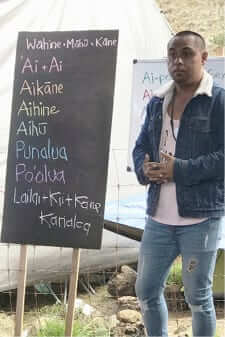
To our ancestors, the world was fluid, relational, and alive. And part of that Indigenous landscape and worldview are māhū. More than simply an identity, māhū held specific kulana and kuleana (roles and responsibilities) within traditional Hawaiian society – a vital, integrated presence that helped sustain the entire ecosystem of our lāhui.
Māhū embody a concept rooted in our cosmology and history. The word needs no translation, only remembrance, just as ʻōlelo Hawaiʻi, like other Austronesian languages, flows with fluidity in its non-gendered pronouns, with the word ʻo ia embracing “he, she, and it” as one.
Across Moananuiākea, many Pacific peoples honor similar roles: faʻafafine in Sāmoa, fakaleiti in Tonga, akavaʻine in the Cook Islands, vakasalewalewa in Fiji, kakōl in the Marshall Islands, wininmwáán in Chuuk, and takatāpui and whakawāhine among Māori.
These identities reflect a vast network of gender diversity that existed long before the advent of colonial violence and continues to defy its boundaries today.
Some scholars have described māhū as living within and between the wā, the generative spaces of kāne and wahine.
Author, activist and co-founder of Māhū Ola Dr. Kahala Johnson offers this metaphor: “The Hawaiian kauhale (traditional housing complex) includes a plurality of living and working spaces that allow an ʻohana to fulfill both specific and shared kuleana. Like the kauhale, the pilina between māhū, wahine, and kāne exists as a way for our lāhui to create a home together.”
In traditional Hawaiian culture, Māhū are not outsiders or outliers. They are essential threads in the tightly woven fabric of our relational universe that nourishes the social and spiritual health of our communities.
“Māhū exist in pilina with wāhine and kāne, and it is this relationship that situates my understanding of māhū within, against, beneath, and beyond the patriarchal binaries imposed by U.S. settler colonialism upon Kānaka Maoli,” Johnson said.
Historically, māhū were respected, honored, and celebrated for the care they held for the community. Māhū were also political leaders and protectors, and Johnson proudly claims Kauholanuiamahu as a political ancestor, “who challenges the false assumption that māhū are apolitical or uninvolved in the affairs of warcraft, peacecraft, statecraft, economy, or diplomacy.”
Kauholanuiamahu became the aliʻi ʻaimoku over Maui and Hawaiʻi, built the fishpond of Keoneʻōʻio in Honuaʻula on Maui, and quelled a rebellion incited by a rival chief. Johnson says that remembering these stories normalizes māhū as political figures and gives māhū today a rightful kuleana claim to power.
Beyond māhū, traditional Hawaiian culture included aikāne and punalua relationships — intimate, same-gender bonds like the one between Kamehameha III and his half-Hawaiian, half-Tahitian partner, Kaomi Moe — which carried their own forms of authority and legitimacy.
Along with Western contact and later, occupation, came the introduction and eventual internalization of foreign ideologies including homophobia and transphobia. External violence transformed into intergenerational harm, a process Johnson calls “māhūcide,” which he describes as the “systematic erasure of māhū from ʻohana and lāhui.”
This historical and existential harm echoes in the mental health crises and high suicide rates among māhū youth. What was once honored was turned into a source of shame and a slur. That shame has lodged itself deeply within our lāhui.
To remediate the systemic harm inflicted upon our māhū community, the kuleana of the larger community should be “one of aloha and unwavering accountability” Johnson said, adding that māhū must be defended with the same fierce dedication our lāhui shows for Kahoʻolawe, Maunakea, Kapūkakī, and our sovereignty.
Māhū as an identity carries profound teachings about transformation, a core value in our cosmology. According to Johnson, “māhū exist and create our maoliness within a Hawaiian cultural ecology already attuned to the endless shapeshifting patterns of ʻāina, body, and desire.
“The land changes, the tides change, the moons change, the stars change, the akua change. When you recognize that life is constantly transforming, you understand transformation as the piko of our worldview, grounded in Pō. Attempts to resist this change or confine our existence into rigid binaries are antithetical to life itself.”
Johnson uses coral as an example, explaining that corals exist in a multitude of combinations. “Coral can change, can reproduce with itself or by itself. The coral polyp is a progeny of its mākua, Pō, which exists in a cosmic network of relations and pluralities far beyond human embodiment. Wā itself — time, space, vocality, interlude — is māhū. The foundation of our mana is nocturnal and cosmic, and that power of creation emerges through us as us.”
Johnson calls for the urgent creation of culturally grounded spaces like Māhū Ola on Maui, which is a collaboration between Hui No Ke Ola Pono, Maui Medic Healers Hui, and Maui AIDS Foundation.
To young Kānaka Maoli reconciling their māhū identity, Johnson offers a call to courage and responsibility: “Politicize deeply, politicize early. Never let anyone, including me, tell you that māhū do not belong to our movements for sovereignty and liberation. Take up space and create a better world for the 17th Wā, for the next pilina to emerge from the Pō beyond māhū, wāhine, and kāne.”
Māhū are not here to be crushed, erased or forced into uniformity. As Johnson declares, “We are ʻhammahs,’ not nails.”



%20within%20traditional%20Hawaiian%20society%20%e2%80%93%20a%20vital,%20integrated%20presence%20that%20helped%20sustain%20the%20entire%20ecosystem%20of%20our%20l%c4%81hui.)