Read this article in ʻŌlelo Hawaiʻi
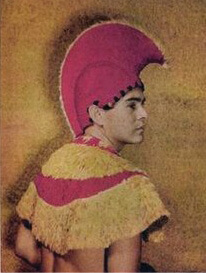
Greetings of affection to the friends of this newspaper column. Because of the interest in the article just printed about Kauaʻi style helmets, here is a short story about the helmet belonging to Kaumualiʻi, the last great ruler of Kauaʻi. This helmet was gifted to Kaumualiʻi by Kamehameha. It is the only helmet in the Bishop Museum whose provenance is known for sure.
Kamehameha gave the helmet, a cape, and other treasures at peace negotiations in 1810. Kamehameha had attempted to conquer Kauaʻi like the other islands, but his regatta of pepeleu ships sank in a storm on a first attempt, and on another occasion, his men succumbed to dysentery.
In a Hawaiʻi Island story, Kamehameha landed on Kauaʻi with confidence in a prophecy of his kahuna. The seer saw the rising of Kamehameha’s star over Kauaʻi’s star. According to the kahuna, Kauaʻi would fall to Kamehameha. When they arrived on Kauaʻi, they prepared for war thinking it would be over quickly. Kaumualiʻi responded by saying, “Best you return and look for me when the black tapa covers me and the banks of clouds are at the summit, then, come and claim your land.” Therefore, Kamehameha left but died before Kaumualiʻi.
In 1821, the heir to the throne, Liholiho, travelled to Kauaʻi on the Pride of Hawaiʻi. Liholiho assured Kaumualiʻi that the sovereignty of Kauaʻi would continue but there was no truth to the king’s words. The new king enticed Kaumualiʻi to visit his ship and while he was looking at the wondrous things aboard the ship, the anchor was pulled up and the Pride of Hawaiʻi sailed to Oʻahu and Kaumualiʻi became a hostage of the nation. Liholiho did not honor the agreement of his father.
Kaumualiʻi returned to Kauaʻi for a visit sometime after he married Kaʻahumanu and shortly after the last sovereign of Kauaʻi died. Kaumualiʻi had a desire to be laid to rest with Keōpūolani at the cemetery at Waiola Church in Waineʻe, Lahaina. That was in 1824. They were cousins and both knew the life of someone taken as hostage. The helmet was cared for by a missionary by the name of Whitney and it was later transferred to the Bishop Museum.