By Leslie Līhaunani Enriquez Rosehill
For the ʻohana of Kaimū, Puilima is an integral part of our foundation as a community. It has been a fishing ground for our families for generations, and our united, familial identity is rooted in the continued, unbroken use and stewardship of its resources.
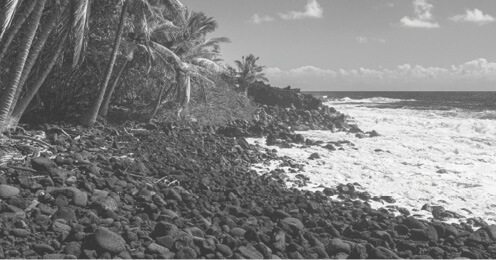
In the wake of the pele (lava flow) that claimed much of the coastline of Kaimū, Kalapana, Kapaʻahu, and the many ʻili ʻāina associated with our ʻohana, Puilima is a pristine resource on our ancestral coastline for a peripheral, Kānaka community that has always relied on self-sufficiency and subsistence-based lifestyles.
Untouched by pele for over 200 years, Puilima immediately neighbors a singular limu and tidepool ecosystem – there is no other place like it on this shoreline. Today, this revered space faces challenges from a proposed gated subdivision, illegal land activity, and environmental violations.
Local real estate investors, on behalf of domestic limited liability company Kaimū Cove, LLC, applied for a Special Management Area (SMA) permit to build a gated subdivision of five homes on a 3.8-acre coastline parcel adjoining Puilima, and directly opposite a family cemetery, Kaipuuelelu.
In 2022, this company received a notice of violation and order for the illegal and unauthorized grading and grubbing of their property, where an irreplaceable grove of kupuna milo and at least one of four archeological sites identified in a 1992 survey were destroyed.
A traditional fishing trail was bulldozed and made into a driveway, over which two welded gates now block our access. For we who descend from the kūpuna who cherished Kaimū and the kūpuna who are buried here, the continued desecration of our wahi pana by developers is intolerable and impermissible.
The legal boundaries of Kaimū Cove’s property do not alienate it from the wider ahupuaʻa of Kaimū, the broader history of gated communities and subdivision development projects, and the continued undermining of the integrity of our descendant community in Puna.
Kaipuuelelu Cemetery, a cultural feature directly tied to Puilima and directly ma uka of Kaimū Cove’s property, is a pristine example of intact generational kuleana to Kaimū; it is a rare and unbroken cultural practice that connects us today to our kūpuna of antiquity.
In a petition created in opposition to the development, urgent concerns include not only the desecration and unauthorized alterations of living heritage, but also the illegal encroachment on designated conservation areas and shoreline zones, violating land use regulations and threatening fragile ecosystems.
No formal engagement with lineal descendants was conducted before the SMA application. This omission violates ethical standards that empower the legal standing of Kānaka who have kuleana to the land. It was stated in the application read at the October Windward Planning Commission hearing in 2024 that there was “no community opposition.”
This is profoundly untrue.
In May 2025, the ʻohana of Kaimū invited developers to join us in a conversation about Puilima’s cultural, historical, and sentimental worth, as well as the truth behind our opposition. The information we shared was disregarded and dismissed by Kaimū Cove, leading to further erosion of trust and ongoing pain.
Despite the clear cultural significance of Puilima and Kaipuuelelu, no Cultural Impact Assessment has been submitted despite requests to Kaimū Cove from then Planning Director Zendo Kern to provide one.
The ʻohana of Kaimū stands united and calls for the immediate withdrawal of the SMA application, a full review of the cultural and environmental impacts of Kaimū Cove’s actions, and the continued protection of Puilima as a protected ʻāina kūpuna.
Our advocacy is the collective effort of our hui and ʻohana to uphold cultural integrity and resist erasure. The mana of our ʻāina is profound, enhanced by the calling given to those of us who live in constant proximity to Kīlauea: take nothing for granted and culture is not passive. It must be actively embodied and fiercely protected, or we risk losing it forever.
As awareness spreads, we hope that Puilima will be saved, and that Kaipuuelelu Cemetery will be treated with the respect it deserves.
Kaimū is a place of modesty. We believe that ʻāina should be treated with decency, with reverence, and with discernment.
If this project continues – or any project that injures our kūpuna and seeks to redefine the terms of their memory – and we do not stand and fight for the integrity of our wahi pana, future generations of Kānaka stand to not only lose their foundation, but also their will to embody their kūpuna and fight for what is right.
Leslie Līhaunani Enriquez Rosehill is a kamaʻāina of Kalapana, Kaimū, in lower Puna on Hawaiʻi Island. For more information, email Līhau at [email protected]. To show your support for the ʻohana of Kaimū, sign their petition using the QR code or go to: chng.it/LCCwnnCgrM.