
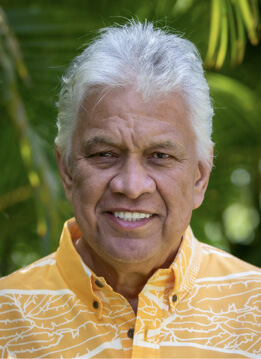

There’s an undocumented organizational chart that John De Fries follows as executive director of the Maunakea Stewardship and Oversight Authority (MKSOA).
“The mountain is above the governor – is above all branches of government – because ultimately, no matter where you stand in that org chart, we’re all accountable to Maunakea,” said De Fries.
“It’s just easier for me to keep that image constantly, because, in a cultural context, the spirit of that mountain is something real, and something that I personally feel accountable to.”
That guiding philosophy shapes the work of the MKSOA, which was created by state legislation in 2022. In July 2023, it began a five-year transition to assume governance of all general leases, easements, and permits for Maunakea currently held by the University of Hawaiʻi and the state Department of Land and Natural Resources.
De Fries became the executive director in 2024 after approval from the 12-member board. Most of the board is Native Hawaiian, including several who were at the forefront of Thirty Meter Telescope (TMT) protest demonstrations on Maunakea in 2019.
Dr. Noe Noe Wong-Wilson, MKSOA vice-chair, is one of them.
“Being on the mauna was very emotional. And still to this day, you know, we carry that emotion deep in our naʻau,” said Wong-Wilson.
Although the MKSOA is a state government entity, its board’s composition has deeply shaped the way it operates, embedding cultural protocol and Hawaiian ʻike into every meeting and decision-making process.
“We ground ourselves in our cultural perspective,” said Wong-Wilson. “We open every one of our meetings either with a pule or we give the individual authority members the opportunity to reflect, to say something, to set our intention for the day.”
In July 2023, the MKSOA began co-management of Maunakea and is now developing a new, culturally responsive and sustainable management model for the mauna. The management plan requires community input and once approved, the MKSOA will assume full management duties on July 1, 2028.
In 2024, the Office of Hawaiian Affairs (OHA) challenged the constitutionality of Act 255, which established the MKSOA. In June 2025, OHA withdrew its challenge, acknowledging the need for a new approach to Maunakea stewardship and advocacy, and pledged its support to the Native Hawaiian leaders currently serving on the MKSOA.
There’s a lot of work to be done in a short timeframe.
“Act 255 requires us to come up with our own management plan, our own master plan, and our own financial plan,” noted De Fries. “We’re going to need every day, every week left on the 34-month clock to get that done.”
The MKSOA meets the second Thursday of each month. It hosts “Community Talk Story” gatherings in districts across Hawaiʻi Island, although attendance has been low.
“Some of us have never served on government boards or commissions before, and so what really drives us is to ensure that every step of the way we engage community in what we’re doing,” said Wong-Wilson.
“And sometimes it can be frustrating because we’ll hold community meetings and we’re not certain if people are just not well informed that our meetings are taking place, or [if it’s] because TMT is no longer the hot topic issue.”
The TMT project shifted away from Maunakea after losing National Science Foundation funding following federal budget cuts in June 2025.
Maunakea remains home to 13 telescopes. As part of its long-term stewardship commitments, the University of Hawaiʻi has pledged to remove five telescopes from UH-managed lands. Since 2024, three have been decommissioned.
“I don’t discount the earnest aloha that people have for the mauna and the gifts that the mauna provides for us,” said Wong-Wilson. “The biggest challenge, for me personally, has been to be able to sit and listen with open ears and open heart and open mind to the various points of view and the people whose livelihood depends on being on the mauna.”
This kuleana for extensive community engagement while safeguarding the mauna’s integrity and sanctity, now rests with Kua o Wākea, a team of consultants recently contracted by the MKSOA to develop a comprehensive Maunakea Management Plan. Kua o Wākea is led by SSFM Consulting, nonprofit DTL Foundation, and the Edith Kanakaʻole Foundation. It has additional support from Mahina Paishon Consulting, Kōnane Law, Hoʻopili Hou Research Group, and ʻĀina Archaeology.
Meanwhile, the slow pace of government checks and balances continues to frustrate the MKSOA, which must navigate procurement procedures to hire needed staff.
“It just takes a long time for us to get anything done given the processes that we’re forced to work under as a state agency. And not only that, but we’re also brand new. So, we’re building the vehicle while we’re driving down the road,” said Wong-Wilson.
On March 27, 2025, Maunakea was designated a Traditional Cultural Property and District on the National Register of Historic Places by the United States government.
“I think there’s also irony in the fact that the creation of the authority was to give more voice locally, right? And something like the national designation requires an additional tier of review,” said De Fries. “But I certainly appreciate the fact that people who care about Maunakea wanted to ensure that the highest level of scrutiny available by law would be applicable.”
Even with those extra layers of oversight, the MKSOA’s commitment is unwavering.
“Our focus is taking care of Maunakea and making sure that for future generations, we do so in a way that Maunakea will be healthy in all of its splendor and all of the ways that she feeds us,” said Wong-Wilson.



.)