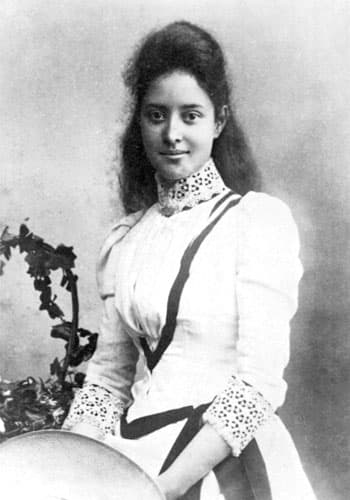
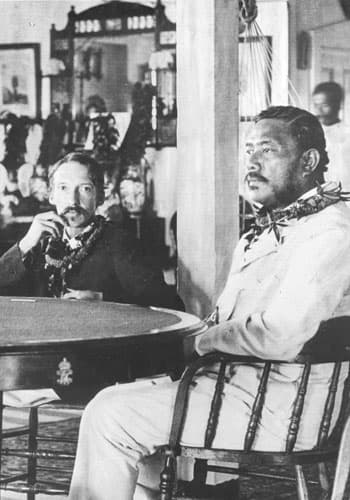
(L) Princess Kaʻiulani, age 17, at school in England in 1892. (R) Poet Robert Louis Stevenson with King Kalākaua in 1889. – Courtesy Photos
By Gene Kaleo Parola
In the aftermath of the Civil War, the American government began to reconstruct the South and, infected with the virus of ʻmanifest destiny,’ began to flex its muscles towards westward expansion. Alarmed by these developments, Hawaiʻi’s monarchy feared a predatory takeover by America even as the influence and power of foreigners increasingly affected economics in the kingdom.
In 1887, King Kalākaua was forced at gunpoint to sign a new constitution severely limiting the power of the monarchy (the so-called Bayonet Constitution). Two years later, amidst this backdrop of political turmoil, acclaimed Scottish writer Robert Louis Stevenson arrived in Honolulu from his first South Seas sojourn. It was January 1889.
Stevenson was ill and late in finishing his manuscript, The Master of Ballantrae. His reputation, having preceded him, further delayed its finish as many prominent islanders made demands on his time and health.
King Kalākaua, himself a poet, became an early friend and introduced Stevenson to fellow Scotsman Archibald Cleghorn.
Like other wealthy foreigners, Cleghorn had married into Hawaiian royalty, his wife being Princess Miriam Likelike. Their daughter was named Victoria Kawēkiu Lunalilo Kalaninuiahilapalapa Kaʻiulani. To the world, simply Princess Kaʻiulani.
Cleghorn was an amateur botanist, and on the huge parcel of land in Waikīkī, ʻĀinahau, given to the family by Kaʻiulani’s godmother Princess Ruth Keʻelikōlani, he had expressed his talents to the fullest. It was a veritable Eden of trees, plants, and flowers from around the world. Its centerpiece was a giant banyan tree under which the young princess often sat feeding her pet peacocks.
Whenever Stevenson visited the Cleghorn home, the huge banyan tree in the yard became his refuge.
When he wasn’t working on his manuscript, Stevenson often sat on the stone bench beneath the banyan tree, enthralling Kaʻiulani with stories about the great world that was beyond her experience, but not her imagination. Knowing that she was soon to attend school in London, he took time to prepare her for that rainy place and its rigid class system.
Stevenson had fallen hopelessly in love with Polynesia and was a hearty anti-colonialist. His recent experience in Samoa had made him aware of how much the people of Oceania needed education and leadership to attain – and maintain – their freedom.
It soon became obvious to Stevenson that prominent domestic interests were a greater threat to the Hawaiian throne than foreign seizure. As the Cleghorns were also royalists, the young princess overheard many political discussions in her home.
Kaʻiulani was enamoured of this strange pale man who spoke unlike anyone else – even if she did think his hair needed cutting. The princess had learned to read early and the value of having a poet as a friend was not lost on her.
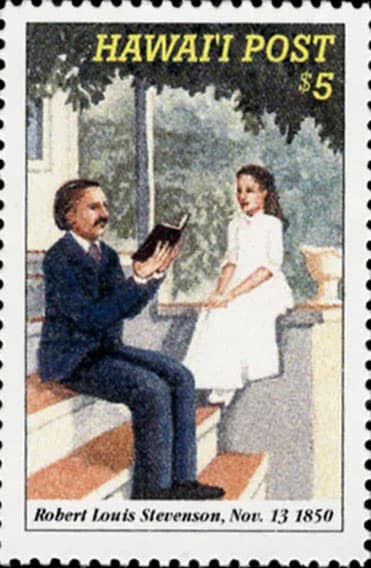
Kaʻiulani was scheduled to depart for England in May 1889. She still had not fully recovered from the untimely death of her mother in 1887 and the prospect of being away from Hawaiʻi in a strange country weighed heavily on her spirit. Stevenson’s famous poem for Kaʻiulani was intended to cheer her.
Forth from her land to mine she goes,
The island maid, the island rose,
Light of heart and bright of face,
The daughter of a double race.
Her islands here, in Southern sun,
Shall mourn their Kaʻiulani gone,
And I, in her dear banyan shade,
Look vainly for my little maid.
But our Scots islands far away
Shall glitter with unwonted day,
And cast for once their tempests by
To smile in Kaʻiulani’s eye.
He wrote the poem in the princess’ little red album and added the following note:
“Written in April to Kaiulani in the April of her age; and at Waikiki, within easy walk of Kaiulani’s banyan! When she comes to my land and her father’s, and the rain beats upon the window (as I fear it will), let her look at this page; it will be like a weed gathered and pressed at home; and she will remember her own islands, and the shadow of the mighty tree; and she will hear the peacocks screaming in the dusk and the wind blowing in the palms; and she will think of her father sitting there alone. – R.L.S.”
Soon afterwards, Stevenson returned to Samoa, where he lived for many years as a favored outsider.
King Kalākaua passed away in 1891, and the threat to the crown grew. A year later, Queen Liliʻuokalani, her hand on a shaky throne, wrote to Kaʻiulani, describing the looming danger.
America, needing a coaling station to refuel its new fleet of steam warships, had aggressive obligations in its looming war with Spain. It acquired access to Pearl Harbor via the Reciprocity Treaty of 1875 even before annexing the Hawaiian Islands to itself in 1898.
Following the 1893 overthrow, Kaʻiulani traveled from England to Washington, D.C., petitioning President Grover Cleveland himself for the return of the Hawaiian nation to its people, but to no avail. Disheartened, she returned to Europe.
In 1897, Kaʻiulani returned to Hawaiʻi and continued her activism, making impassioned pleas on behalf of her people to the clutch of planters running the hastily created “Republic of Hawaiʻi.”
Kaʻiulani boycotted the 1898 Annexation Ceremony. However, that same year she hosted a U.S. Congressional Delegation at her home to discuss the formalization of the Hawaiian Organic Act for the newly established “Territory of Hawaiʻi” in an effort to ensure voting rights for Native Hawaiians.
The following year, in March 1899, she fell ill and died at the age of 23.
Upon her father’s death in 1916, ʻĀinahau became coveted Waikīkī real estate. The plot containing the banyan tree was initially designated as a small park. A bronze plaque in memory of Princess Kaʻiulani was affixed to the tree in 1930 by the Daughters of Hawaiʻi.
The plaque, featuring a relief of a banyan tree with a peacock in the lower corner included several lines from Stevenson’s poem and an inscription:
“The daughter of a double race.
Her islands here, in Southern sun,
Shall mourn their Kaʻiulani gone,
And I, in her dear banyan shade,
Look vainly for my little maid.
“Written to Kaʻiulani by Robert Louis Stevenson who often sat here with her.”
When the Princess Kaʻiulani Hotel was built on the ʻĀinahau site in 1955, the plaque was moved to Princess Kaʻiulani School in downtown Honolulu. The school was founded in 1899, the year of her passing, and its first principal, L.D. Fraser, asked Archibald Cleghorn for a cutting from the famous banyan tree. The cutting was planted on the school grounds and has flourished over the last 126 years. The new tree, child of the original, now bears the plaque.
Gene Parola married into a Native Hawaiian-Chinese family in 1955. He met his future wife, the former Shirley Tong, backstage when they were both involved in a local production of “Teahouse of the August Moon.” They traveled together to the continent for graduate school and worked as teachers, finally returning to Hawaiʻi in 2000 after retiring. Gene, now 92 years old, spends his time researching and writing about Hawaiian history.