By Brook Kapūkuniahi Parker
Kaʻiana was the son of Ahuʻula, son of Aliʻi Nui Keaweikekahialiʻiokamoku of Hawaiʻi Island. His mother was Kaupekamoku, a high-ranking chiefess connected to the ruling families of Oʻahu and Maui. Born in 1755, Kaʻiana was raised on Kauaʻi with his half-brothers Nāmākēhā and Nāhiʻōleʻa. All three were acclaimed warriors who remained close their entire lives.
Kaʻiana was the first aliʻi to travel abroad, visiting China, the Philippines, Melanesia, and the Northwest Coast of America. In China, Capt. Nathaniel Portlock said, “his very name [was] revered by all ranks and conditions of the people of Canton.”
In 1787, Irish born captain and fur trader John Meares wrote, “Tianna (Kaʻiana) was about 32 years of age; nearly six foot five inches in stature, and the muscular forms of his limbs was of an Herculean appearance.”
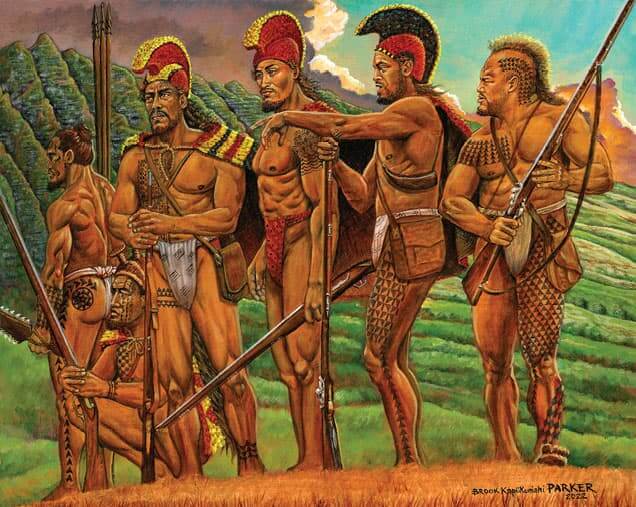
Kaʻiana was well-respected and friendly with the foreign traders and ship captains he met. Because of his travels, he became adept at the complexities of international trade and mastered Western weaponry, accumulating a personal arsenal of weapons and munitions.
After returning home, he settled on Hawaiʻi Island and was welcomed by Kamehameha. Kaʻiana’s family joined him there. Kaʻiana became a valuable addition to Kamehameha’s army and was made pūkaua (war leader).
On Maui, he fought against Kahekili and Kaʻeo. On Hawaiʻi, Keōua Kūʻahuʻula, cousin to both Kamehameha and Kaʻiana, took up arms to assert his claim of sovereignty over the island. Kaʻiana was Kamehameha’s commander in his campaigns against Keōua, leading the infamous “Mahi” military division.
Amidst the political turmoil, other changes were being forced on the people as more foreign ships visited the islands. Many of whom had heard of Kaʻiana before they arrived.
Kaʻiana’s name was attached to many events during those years, sometimes fairly, sometimes not. He reportedly plotted to seize no fewer than eight foreign ships between 1789-1792. But similar stories were circulated about most of the chiefs.
In truth, the only vessel seized by Hawaiians was the Fair American off North Kona in 1790. All the crewmen except Isaac Davis were killed. Although history names Chief Kameʻeiamoku as the one responsible, at least three foreign captains were told it was Kaʻiana.
It was also Kaʻiana who foiled the plan of John Young and Isaac Davis to escape the Islands aboard the Argonaut in 1791. Learning of the plan by chance, Kaʻiana informed Kamehameha who intercepted the Englishmen as they made their way to the ship. Kaʻiana offered to kill them for making the attempt. Kamehameha firmly rejected his offer, but Kaʻiana earned the enduring enmity of Young and Davis.
Capt. George Vancouver visited the Islands three times in 1792, 1793, and 1794. The first chief he encountered on his arrival in 1792 was Kaʻiana, who met the ship in a double-hulled canoe paddled by 42 men.
Vancouver knew of him from Meares’ writings, and the meeting was friendly. Kaʻiana’s family dined and slept aboard Vancouver’s ship, the Discovery.
Later, on Kauaʻi, Vancouver learned of the Fair American massacre and was told Kaʻiana was behind it. Vancouver later met Kamehameha and spoke with Young and Davis. From these discussions Vancouver changed his opinion of Kaʻiana and Nāmākēhā and wrote of “their turbulent, treacherous, and ungrateful dispositions” and of Kaʻiana’s “crimes and misdemeanors.”
Published in 1798, Vancouver’s journals would provide extensive information about the Hawaiian Islands in the early 1790s and thus his depiction of Kaʻiana as villainous has largely replaced the amiable chief described earlier by Meares and Portlock.
There were also rumors regarding Kaʻiana and Kaʻahumanu, Kamehameha’s favorite wife. The story of the Kamehameha-Kaʻahumanu-Kaʻiana love triangle was recounted by Vancouver in a few sentences written in 1794 in which he described Kaʻahumanu as “one of the finest women we had yet met on any of the islands.”
During Vancouver’s third visit to Hawaiʻi, Kamehameha visited the Discovery without Kaʻahumanu. Asking after her, Vancouver was told that she and Kamehameha had separated because of a report “that too great an intimacy had subsisted between her and Tianna” although “the infidelity of the queen was by no means certain.”
In 1795, after the deaths of Kahekili and Kaʻeo, Kamehameha sailed from Hawaiʻi with his vast war fleet to subjugate Maui Nui. Kaʻiana and his brother, Nāhiʻōleʻa, with their contingent of canoes and warriors, were part of Kamehameha’s invasion force. For reasons not known, the third brother, Nāmākēhā, remained on Hawaiʻi Island.
After devastating Lahaina, the fleet sailed on to Molokaʻi where Kaʻiana was excluded when Kamehameha’s war council convened at Kaunakakai. Concerned for his life, Kaʻiana concluded that the Hawaiʻi Island chiefs had turned against him.
He consulted with his cousins Namahana and Kalanimoku to learn what the chiefs were secretly discussing, but to no avail.
Suspecting a betrayal, Kaʻiana and Nāhiʻōleʻa decided that when the fleet set sail to attack Oʻahu, they would join Oʻahu’s defending army. Their cousin, Kalanikūpule, son of Kahikili, reigned as king of Oʻahu.
Kaʻiana told his wife, Kekupuohi, of his intention. She sadly told him her choice was to remain with Kamehameha. Kekupuohi led a corps of aliʻi wāhine warriors who were very proficient in using the foreigners’ muskets and deadly accurate – skills she had learned from Kaʻiana.
Kamehameha’s fleet landed on Oʻahu at Waiʻalae and Waikīkī, but the contingent led by Kaʻiana diverted to the windward side of the island, landing at Kailua. From there they crossed over Nuʻuanu Pali to join Oʻahu’s army.
There are differing versions of Kaʻiana’s final battle, but it seems certain that both he and Nāhiʻōleʻa were killed early on near the present location of Queen Emma’s Summer Palace.
According to historian Stephen L. Desha, Kaʻiana fought bravely but was hit three times with musket balls to the chest. He kept fighting until he was shot in his left thigh and fell, suffering great loss of blood from his many wounds.
Kekupuohi saw him fall and ran without hindrance to where he lay. Kaʻiana, barely alive and unable to speak, gazed upon his beloved warrior wife who had fought against him for the last time in this life.
She lifted his head upon her lap and tears of love flowed freely. Before his last breath, Kekupuohi caressed her beloved husband and this tragic sight on that terrible battlefield touched the hearts of the onlookers. It is said that the shooting on both sides stopped as both enemies and friends shed tears of sadness. Kekupuohi then chanted a farewell oli.
Another well-known version has it that Kaʻiana was felled by a cannon ball fired by his old enemy John Young.
Kamehameha triumphed that day – though he lost 6,000 of his 16,000 warriors – securing his rule over all the islands from Hawaiʻi to Oʻahu.