
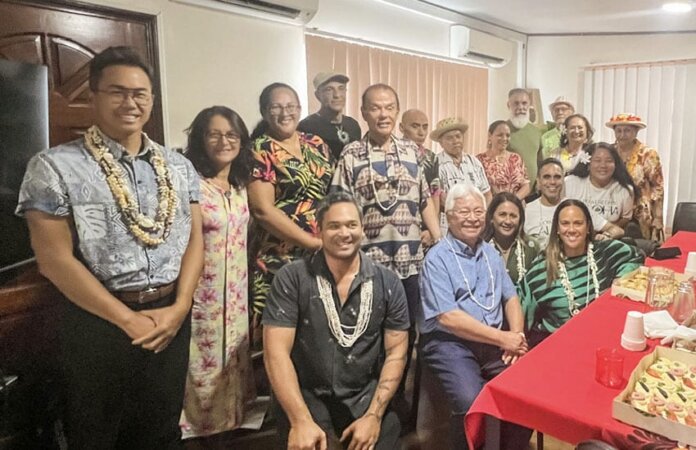
An August meeting at the French Polynesia Ministry of Education and Culture in Papeʻete, Tahiti, marked the inaugural gathering of Indigenous language advocates from Hawaiʻi and Māʻohi Nui (French Polynesia) for the purpose of strengthening collaborative relationships and developing strategies for advancing the normalization of both ʻōlelo Hawaiʻi and reo Māʻohi.
In addition to ministry representatives, the meeting brought together representatives from Fare Vānaʻa (Tahitian Academy), Puna Reo (Tahitian language preservation association), and Parliament’s Committee on Tourism and Culture to meet with representatives from ʻAha Pūnana Leo, Ka Haka ʻUla o Keʻelikōlani College of Hawaiian Language, and the Office of Hawaiian Affairs (OHA).
“It was an opportunity to connect – and in some cases reconnect – and to affirm our shared aloha for and commitment to our ʻōlelo ʻŌiwi and our desire to see future generations continuing to speak and live through them,” said UH Hilo University Relations Director Amy Kalili.
A connection was made last January when representatives from the Ministry of Education and Culture visited Pūnana Leo o Nuʻuanu while they were in Honolulu as part of the Māʻohi delegation that met with representatives of OHA and Kamehameha Schools to sign a Cultural Heritage, Education and Community Exchange Charter that formalized bonds of friendship and mutual support between the Hawaiian and Māʻohi peoples.
That charter was expanded on July 30 to include representatives from Aotearoa (from the district of Whangarei) and Rapa Nui (Easter Island) in addition to Hawaiʻi at a formal signing ceremony at Taputapuātea Marae on the island of Raʻiātea, hosted by the mayors of the island’s three municipalities.
A key element of the charter commits the nations to being supportive and willing partners in promoting culture-based education so “language-specific collaborations are a prime example of that effort,” Kalili noted. “It’s an opportunity to forge new working relationships and agreements with both government agencies and non-governmental organizations to collaborate on ways to address challenges we face individually.”
The meeting began with both the Tahitian and Hawaiian educators sharing their current “status of the language” reports, including initiatives and progress, as well as their unique challenges, then segued to discussions about ways to navigate English- and French-dominant governmental and educational systems.
“Conversations centered on rekindling previous partnerships – such as the pilina once fostered through the Polynesian Languages Forum – as well as forging new collaborations,” shared UH Hilo Native Hawaiian Engagement Director Pelehonuamea Harman. “Ideas for future work include student and teacher exchanges, collaborative lexicon development, and joint advocacy for increased Indigenous language presence in education systems.”
Harman noted that while some Māʻohi programs currently operate within school settings that teach reo Māʻohi as more of a second language, there is strong interest in moving toward more immersive models, alongside social and intersession programs like those offered by Puna Reo.
That poses a specific challenge for Māʻohi educators. In Hawaiʻi, because both Hawaiian and English are “official” languages, funding for Hawaiian medium education is required by law. However, in French Polynesia – which is an “overseas collectivity” of France and economically dependent on them for government funding – the only “official” language, and therefore the only medium of instruction in French Polynesia, is French.
UH Hilo Hawaiian Language Professor Dr. Kalena Silva shared that the Māʻohi representatives at the gathering brought up another critical difference between native language education and use there, as compared to Hawaiʻi.
“Whereas French Polynesia has five major dialects, at least one of which is quite different from the others, Hawaiʻi has a single native language,” Silva said. “This fact probably makes decisions about where native language support and resources are directed more complicated in French Polynesia than in Hawaiʻi. Although Tahitian is the most widely spoken dialect, understandably, speakers of the other dialects also want language support.”
French Polynesia has a total population of about 282,000 – 85% of whom are Indigenous Māʻohi.
Considering this, Silva called out another significant fact: there are currently more speakers of the various reo Māʻohi dialects than there were Hawaiian speakers when Hawaiian language immersion education began in the early 1980s.
“Most French Polynesians over 30 years of age have knowledge of at least one of the five dialects, whereas less than 1% (only about 2,000 Hawaiians) could speak Hawaiian in the 1980s,” Silva noted. “So, if French Polynesians act concertedly now, their language revitalization efforts will likely bear fruit more quickly than ours did in Hawaiʻi.”
In addition to Kalili, Harman and Silva, UH Hilo representatives at the meeting included Ka Haka ʻUla o Keʻelikōlani Hawaiian Language Professor Dr. Larry Kimura and Associate Professor Dr. Kekoa Harman, and Ka Haka ʻUla o Keʻelikōlani Director and ʻImiloa Executive Director Kaʻiu Kimura.
Meeting participants agreed that the gathering represented an important first step in building sustained, purposeful pilina between ʻōlelo Hawaiʻi and reo Māʻohi advocates, and in strengthening the bonds that already connect the islands and peoples of Moananuiākea.
“The meeting between ʻōlelo Hawaiʻi and reo Māʻohi advocates is a reminder that the survival of a language is inseparable from the survival of a people’s soul,” said OHA Sr. Director of Hawaiian Cultural Affairs Hailama Farden.
“Hawaiʻi knows the pain of language loss and the painstaking journey of revitalization; it is our kuleana to share our lessons, resources, and solidarity with our Tahitian cousins. Together, we can ensure that reo Māʻohi is not only preserved, but flourishes as a living voice of identity, wisdom, and pride for the next generation.”



%20for%20the%20purpose%20of%20strengthening%20collaborative%20relationships%20and%20developing%20strategies%20for%20advancing%20the%20normalization%20of%20both%20%ca%bb%c5%8dlelo%20Hawai%ca%bbi%20and%20reo%20M%c4%81%ca%bbohi.)